Black Mirror Know You Better Than Yourself
| "Be Right Back" | |
|---|---|
| Blackness Mirror episode | |
 Martha (Hayley Atwell, right) interacts with a synthetic re-creation of her deceased beau Ash (Domhnall Gleeson). | |
| Episode no. | Series two Episode one |
| Directed by | Owen Harris |
| Written by | Charlie Brooker |
| Original air date | xi February 2013 (2013-02-xi) |
| Running time | 44 minutes |
| Guest appearances | |
| |
"Exist Right Back" is the first episode of the 2d series of British science fiction anthology series Blackness Mirror. It was written by series creator and showrunner Charlie Brooker, directed by Owen Harris, and first aired on Channel 4 on xi Feb 2013.
The episode tells the story of Martha (Hayley Atwell), a young woman whose boyfriend Ash Starmer (Domhnall Gleeson) is killed in a motorcar accident. As she mourns him, she discovers that applied science now allows her to communicate with an artificial intelligence imitating Ash, and reluctantly decides to try information technology. "Be Right Back" had two sources of inspiration: the question of whether to delete a dead friend's telephone number from ane's contacts, and the idea that Twitter posts could be made by software mimicking dead people.
"Be Right Back" explores the theme of grief; it is a melancholy story similar to the previous episode, "The Unabridged History of Yous". The episode received positive reviews, with the performances of Atwell and Gleeson receiving universal acclaim. Some critics believe it to be the best episode of Black Mirror, though the ending was met with criticism. Several real-life artificial intelligence products have been compared to the one shown in the episode, including a Luka chatbot that was partially inspired by the episode.
Plot [edit]
Martha Powell (Hayley Atwell) and Ash Starmer (Domhnall Gleeson) are a immature couple who have moved to Ash's remote family firm in the countryside. The day after moving in, Ash is killed while returning the hired van. At the funeral, Martha's friend Sarah (Sinead Matthews) talks about a new online service which helped her in a like situation. Martha yells at her, but Sarah signs Martha upwardly anyway. Afterwards discovering she is pregnant, Martha reluctantly tries it out. Using all of Ash'due south past online communications and social media profiles, the service creates a new virtual "Ash". Starting out with instant messaging, Martha uploads more videos and photos and begins to talk with the artificial Ash over the phone. Martha takes it on countryside walks, talking to it constantly while neglecting her sister'south messages and calls.
At a checkup, Martha hears her child's heartbeat, and on her way out accidentally drops her phone and temporarily loses contact with the artificial Ash. After consoling her, the artificial Ash tells her most the service's experimental stage. Post-obit his instructions, Martha turns a bare, synthetic torso into an android that looks almost exactly identical to Ash. From the moment the android is activated, Martha is uncomfortable and struggles to accept its existence. Despite the android satisfying her sexually, she is concerned by his inability to slumber and absence of Ash'southward negative personality traits. One night, she orders the robot Ash to leave and is annoyed that he does and so, equally the real Ash would take resisted. The next morning, Martha takes the artificial Ash to a cliff and orders him to jump off. As he begins to follow the order, Martha expresses her frustration that Ash would not have simply obeyed. The android begs for its life. Martha screams.
Several years later, information technology is Martha's girl's (Indira Ainger) birthday. Martha keeps the Ash android locked in the attic and only allows her girl to see the android on weekends, but she makes an exception for her altogether. Her daughter chats away to the android while Martha stands at the bottom of the cranium steps, and forces herself to join them.
Product [edit]
| External video | |
|---|---|
 "Be Right Back" "Be Right Back"The trailer for "Be Correct Dorsum". |
"Be Correct Back" was the starting time episode of the 2nd serial of Black Mirror, produced by Zeppotron for Endemol. It aired on Channel iv on xi Feb 2013.[1] On 22 Jan 2013, a trailer for the second series was released, featuring "a dream sequence", a "repetitive manufactory setting" and a "huge dust cloud". The advert ran on Channel 4 and in cinemas.[2] A trailer for "Be Right Back" first aired on 1 February 2013.[3] The episode's title was later invoked as a tagline for the interactive film Black Mirror: Bandersnatch.[iv]
Conception and writing [edit]
The episode was written by series creator Charlie Brooker. A few months after the death of a person he knew, Brooker was removing unneeded contacts from his telephone, and considered information technology to exist "weirdly disrespectful" to delete their name. This thought afterwards became an inspiration for "Exist Correct Back", along with another idea Brooker had when using Twitter: "what if these people were expressionless and it was software emulating their thoughts?"[v]
Prior to the writing of "Be Correct Back", Brooker had read nearly the 1960s bogus intelligence program ELIZA, and how the creator's secretarial assistant was engaged in a very personal conversation with ELIZA inside minutes of first testing information technology.[6] Brooker too considered the inauthenticity of social media users, commenting in another interview that "I found myself being inauthentic on in that location and it reminded me of writing columns for a newspaper".[7] In 2013, Brooker said that he rationed his Twitter usage as it caused him unhappiness.[5]
Several years ago, someone I knew died, and a few months later on I was going through my telephone, making some space by deleting numbers. It felt weirdly disrespectful to delete this person's name. So last year later on we had a baby I spent a lot of time up late and on Twitter, thinking: what if these people were dead and information technology was software emulating their thoughts? And if y'all're grieving, if you've got something you know isn't the person, but evokes enough memories to remind yous of them, is that enough?
Charlie Brooker, Interview with Time Out.[5]
The episode was written shortly subsequently Brooker had his first child with Konnie Huq. The couple took information technology in turns to sentry the baby whilst the other slept, and Brooker wrote the episode during his shifts. The script was written quickly, and Brooker commented that having recently had a infant led the writing to exist "more soppy and emotional" than it may otherwise take been.[8]
In a British Film Establish panel, Brooker notes that the episode mirrors stages of cyberspace dating, progressing from text conversations to phone calls to existent-life interactions, and believes the "biggest leap" to be the synthetic flesh version of Ash, while the balance is "not that far-fetched". Executive producer Annabel Jones compares the engineering science to mediumship, equally both are used for condolement.[half-dozen]
An unused thought for the episode was to emphasise the fiscal nature of the artificial intelligence company. Brooker says in an interview that "there was a point where she runs out of credit and has to top information technology up. I recall that was even shot".[7] Another thought was for the episode to characteristic other characters and their android replacements of loved ones.[ix]
Casting and filming [edit]

Hayley Atwell, who plays Martha, was a fan of the first series of the show, calling it "inventive and very smart", then she asked her agent to go her a role in the second series. Atwell's start impression of the script was that information technology was "really poignant, merely it still had the wit."[10] Asked in a 2013 interview, Atwell said that she was a heavy user of the net.[5] Domhnall Gleeson plays Ash, and said in a 2018 interview that the role led him to try to use his phone less, with a stage management where he aimlessly searches his phone particularly resonating with him.[11]
The episode was directed by Owen Harris, who after directed the series-three episode "San Junipero"[12] – an episode which Harris described every bit "strangely like" to this one every bit both are "relationship-led".[13] Harris was drawn to "Be Right Back" by its "intimate" exploration of "grander themes of dearest and death and loss".[8] Brooker believes that Harris is "very good with performers" and "gravitates" towards Blackness Mirror episodes that are "more tender". Brooker praises Harris' "skillful center for those authentic, bittersweet and painful moments."[fourteen] He describes that the story "on the one hand is about technology and on the other mitt is well-nigh grief".[6] Vince Pope equanimous the episode'south soundtrack.
Atwell was not bad to keep Martha grounded and use naturalism to emphasise Martha'due south grief and aid plausibility of the science fiction concepts. Harris describes Martha as a "girl side by side door" graphic symbol, whose goal was to atomic number 82 a "unproblematic life" with Ash. Earlier filming, Atwell and Gleeson met at Dans le Noir, a eatery in which food is served in darkness.[eight]
Harris wished to make the episode appear every bit if it could be possible in the near futurity, as if i could "walk into the Mac store tomorrow and it wouldn't be out of place to see people trialling software similar this".[6] Production designer Joel Collins said in 2018 that the technology is "almost real now", but "seemed fantastical" at the time. The petrol station has "micro cars", which Collins suggests are electric cars that could be a office of a "simple, small, eco-friendly" futurity.[8] A touch on-screen easel is shown briefly in the episode. Brooker commented that "the design squad had a field 24-hour interval with that easel" and that they suggested copyrighting the idea.[15] Brooker wished to avoid a trope of "histrionic" technology interfaces in television, using more subtle cues such as Martha deleting an electronic mail on her affect-free laptop with a unproblematic paw movement. One e-mail sent to Martha is a targeted advertisement for books well-nigh dealing with grief.[16]
Harris has said that different endings were discussed, but that "I think we pretty much ended upwardly where we'd started". Harris suggested a family dinner downstairs, only Brooker and Jones preferred for Martha to allow her daughter to see Ash one time per week. Atwell described the ending equally "very pessimistic", calling her character "numb" and maybe "medicated". During filming for the terminal scene, Gleeson had begun to grow a bristles for another project; though there was fence over whether the android could have a beard to mark the passage of fourth dimension, it was removed in editing. This was a difficult and expensive procedure, equally Ash has to talk and walk through shadows and lite.[8]
Assay [edit]
"Be Right Back" has grief as a cardinal concept, according to Emily Yoshida of Grantland and James Hibberd of Entertainment Weekly.[17] [eighteen] Luke Owen of Flickering Myth summarised the episode as a "sombre, easygoing and all together depressing affair about grief and how people bargain with it in unlike ways",[19] with Giles Harvey of The New Yorker commenting on the episode's exploration of postmodern grief possibilities, suggesting that a targeted email to Martha about grief "stands for an aggregating of such intrusive moments—the death of solitude by a thousand digital cuts".[16] Other themes in the episode are besides present. Ryan Lambie of Den of Geek believed the episode'due south theme to be "engineering science's effects on relationships".[20] Johnston noted that in improver to grief, the episode explores how people carry in "increasingly mediated public spaces".[21]
The episode was described by Brooker every bit "a ghost story"[vii] and many critics have commented on its tone. David Sims of The A.V. Club described information technology every bit a "spare, haunting slice",[22] though Megan Logan of Changed said that whilst episode is tragic it does contain a "deep-seated optimism".[23] Focusing on the interconnection of content and tone, Charles Bramesco of Vulture wrote that the episode amalgamates a "cognitive sci-fi thought [experiment]" and a "sentimental core", making it a "high-concept tearjerker".[24] Tom Sutcliffe of The Contained connected the episode's tone to a development in Brooker'due south writing since his matrimony and first child, calling it "tender" and "wistful".[25]
Dissimilar past episodes of Black Mirror, "Be Right Dorsum" features a character start to employ a technology, rather than i who is used to it.[17] According to Daniel One thousand. Swain of HuffPost, the episode is a "powerful reminder to the soullessness of social media",[26] and Sameer Rahim of The Daily Telegraph wrote that the episode contains ideas about the falsity of social media personas and growing addiction to the internet.[27] Roxanne Sancto of Paste said the episode "examines our ain mortality and our desire to play God", and demonstrates how humans have a "drastic need to reverse a natural and necessary part of life without considering the consequences".[28]
Other critics posed their thoughts more on the human relationship in the episode, and suggested it was relationship-led. According to Lambie, Ash is "an affectionate beau" and Martha is "blissfully in love", though Ash is hands distracted by his phone; Martha and Ash only announced together in a few scenes, just we come across their dearest through "footling in-jokes, shared honey of cheesy 70s tunes and childhood memories".[20] Bojalad wrote that they are "one of the most realistically comfortable and happy couples" in the series,[29] and Owen agreed, writing that though the relationship has fiddling screentime, the audition experience "an instant connection with them".[19] These scenes are later mirrored: examples include the android Ash disliking the Bee Gees and engaging in sexual activity that feels "robotic".[30] Ash's crusade of decease is "neither clear nor important", though Sims and Sancto idea that it relates to him checking his phone while driving.[22] [28]
Yoshida said that the presence of the android Ash is "menacing" though he has a "docile" demeanour, further commenting that Martha is unable to resist him, despite her repulsion at the situation.[17] Sims stated that the replica of Ash is "self-aware", equally information technology "knows it cannot replace Ash fully". Sims also described the robotic Ash as "like a lost puppy" who follows Martha obediently.[22] Beau noted this non-humanness, too, writing that though the android Ash is witty, his personality lacks meaning,[26] with Morgan Jeffery of Digital Spy calling him "hollow" and commenting that he is missing "then much of what made Ash the homo he was".[30] Logan said the episode is well-nigh "the intangibles of humanness that make up the people nosotros beloved".[23] Sutcliffe believed the robotic Ash fails as a replacement because humans miss their loved ones' "sourness" besides every bit their "sweet".[25]
Comparisons to other media [edit]
In contrast to the previous series opener, "The National Anthem", Brooker described "Exist Right Back" as "more earnest than people might await" also as "melancholy" and "very intimate and personal".[ten] Lambie made similar comments.[20] Lambie and Jeffery both compared the episode to "The Entire History of You", an episode from the starting time series written by Jesse Armstrong.[20] [30] Yoshida noted that "The Entire History of Yous" begins with Liam obsessing over a job interview, which he is able to replay through his grain device. Yoshida compared his disability to drib the thing with Martha'south choice to "forever nurse herself on a slow baste of delayed acceptance" past replacing Ash with an android.[17] Maura Johnston of The Boston Globe said that both episodes have memory as a fundamental concept and "[play] on the ideas of honey and the platonic".[21]
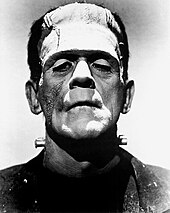
Richard Hand of The Conversation described the episode every bit a "clever reworking" of Mary Shelley's Frankenstein.[31] Yoshida compared the bogus Ash to Frankenstein's monster,[17] with Hand making the same comparison, writing that both are "resurrected figure[s]" that "can never be human being".[31] While Frankenstein demonstrates that the "vital essence of humanity" is more than a drove of body parts, "Exist Right Back" shows it is non the "digital presence" of a person.[31]
Reviewers have used the analogy of "Be Right Dorsum" being like "The Monkey'south Paw" with futuristic technology.[32] [18] Lambie compared the storyline to Ubik by Philip G. Dick and the 1984 motion-picture show Starman, and the cinematography to 2010 film Never Allow Me Go.[twenty] TheWrap noted that the episode "shares some similarities" with 2013 film Her.[33]
Comparisons to AI engineering science [edit]
In 2015, Luka co-founder Eugenia Kuyda used her AI startup resources to build an online service using conversation logs from her tardily friend Roman Mazurenko; "Be Correct Dorsum" was one of the sources of inspiration for the project.[34] Having seen the episode subsequently her friend's death, she questioned of the concept: "Is it letting go, past forcing you lot to actually feel everything? Or is it merely having a expressionless person in your attic?" The Roman Mazurenko chatbot was launched in May 2016 and was met with mostly positive responses, though four of Kuyda'south friends were disturbed by the project and one commented that she had "failed to acquire the lesson of the Black Mirror episode".[35] Some other visitor, Eterni.me, also produces AI that has been compared to the robot Ash in "Be Correct Back"; cofounder Marius Ursache has commented that the company is trying to avert "the concept that it's a way for grieving loved ones to stall moving on" and that the AI depicted in this episode is a "creepier version" of their ideas.[36] [37] Like bots such every bit BINA48, fabricated public in 2010 by Martine Rothblatt, or the 2017 "DadBot" fabricated by journalist James Vlahos, have also been compared to the cardinal conceit in this episode.[38] [39] [40]
Reception [edit]
Starting time airing on Channel 4 on eleven February 2013 at 10 p.chiliad., the episode garnered 1.6 meg viewers, a ix% share of the audition. This was 14% college than the time slot's boilerplate for the aqueduct, but a lower figure than the 1.9 million viewers who watched "The National Anthem", the previous series' first episode.[41] In 2014, the episode was nominated for a British Academy Idiot box Craft Award in the category Best Unmarried Drama.[42]
Disquisitional reception [edit]
On the review aggregator website Rotten Tomatoes, the episode holds an approval rating of 92% based on xiii reviews, with an boilerplate rating of 8.30/10. The website's critics consensus reads: "'Be Right Back' tones down Black Mirror 's typically nighttime humor, but its examination of grief in the age of social media makes it an uncommonly powerful episode."[43] The A.V. Club gave the episode an A− rating.[22] Out of five stars, the episode received iv stars in The Daily Telegraph [27] and Digital Spy.[thirty] Empire ranked the first coming together between Martha and the Ash android as one of the l greatest sci-fi moments in fiction.[44] Prior to the premiere of serial 3, Logan claimed that the episode was "the best episode of the series so far" and the "most heartbreaking".[23] Rahim said that the episode is "a touching exploration of grief" and opined that "it'due south the best thing Brooker has washed".[27] Following the fourth serial, Alec Bojalad of Den of Geek opined that it is the best episode of the show.[29]
Logan praised the storyline every bit a "stunning, linear meditation on grief and love". Lambie believed that the express scope of the episode "intensifies its dramatic strength", and praised information technology as "appropriately haunting".[23] Contrastingly, Mike Higgins of The Contained criticised that the episode failed in its aims as a "social-media satire".[32] Jeffery praised the tone every bit "creepy and moving in equal measure out".[xxx] Sims commented that the narrative arc is "engrossing" despite its predictability.[22]
Jeffery criticised the episode'southward ending as a "cop-out" from Brooker because "like Martha, you lot get the feeling that he doesn't quite know what to practise with Ash at present that he'due south created him."[30] Owen plant that the ending "doesn't actually conclude any of Martha's character progression",[nineteen] while Higgins wrote that "Ash has become but another sci-fi stock robot".[32] Notwithstanding, Sims praised the concluding scene as emotive and "melancholy".[22]
Owen reviewed that Hayley Atwell'southward performance as Martha was the best in Blackness Mirror up to that point in the programme,[19] with Lambie like-minded that it was one of the best.[20] Lambie wrote that Atwell is "the hub of nigh every scene"[20] and Sims plant that she "almost never [lets] her grief feel cartoonish or clichéd".[22] Owen called Domnhall Gleeson'south acting equally Ash "equally as great",[nineteen] while Sims commented of the climax that "[i]t'southward astonishing to sentinel Gleeson turn the emotions on after keeping them bottled in for an entire episode".[22] Lambie opined that Ash and Martha have "a real spark"[20] and Jeffery praised that the episode "has real eye and characters that live and breathe".[30]
Owen praised Owen Harris' directing, reviewing that the familiar surroundings and apparent technology "[added] to the believability of the story."[19] Bojalad wrote that the scene in which the law arrive to inform Martha of Ash's decease is "amidst the most artful and devastating moments Black Mirror has ever presented".[29] Higgins praised the cinematography in the countryside scene.[32]
Episode rankings [edit]
"Be Right Back" appeared on many critics' rankings of the nineteen episodes in Black Mirror, from best to worst:
|
|
Instead of past quality, Proma Khosla of Mashable ranked the episodes by tone, terminal that "Exist Right Back" is the fourth-least pessimistic episode of the show.[52]
Other critics ranked the 13 episodes in Black Mirror 's first three series.
Other reviewers ranked the vii episodes produced under Channel 4. "Exist Right Back" is listed fifth in a Metro article by Jon O'Brien,[59] and ranked sixth-all-time by Roxanne Sancto of Paste.[28]
References [edit]
- ^ "Blackness Mirror – A new drama from Charlie Brooker". Endemol UK. 11 May 2011. Archived from the original on xv May 2011. Retrieved 12 September 2018.
- ^ "MPC creates darkly compelling ads for Charlie Brooker'south Black Mirror". Digital Arts. 29 January 2013. Retrieved sixteen December 2017.
- ^ Westbrook, Caroline (2 February 2013). "New Black Mirror trailer shows Charlie Brooker's sinister take on social media". Metro . Retrieved xvi December 2017.
- ^ Vincent, Alice (20 December 2018). "What is Bandersnatch? Solving the riddle of Black Mirror's secret Christmas episode". The Telegraph . Retrieved 25 Dec 2018.
- ^ a b c d Tate, Gabriel (31 Jan 2013). "Charlie Brooker and Hayley Atwell discuss 'Black Mirror'". Fourth dimension Out . Retrieved sixteen Dec 2017.
- ^ a b c d BFI Q&A - Be Right Back (Video interview). YouTube. 12 February 2013. Archived from the original on 31 January 2014. Retrieved 12 September 2018.
- ^ a b c Temperton, James (xi October 2016). "Charlie Brooker on where Black Mirror will take us next". Wired . Retrieved 16 December 2017.
- ^ a b c d e Brooker, Charlie; Jones, Annabel; Arnopp, Jason (November 2018). "Be Right Dorsum". Within Black Mirror. New York Metropolis: Crown Publishing Group. ISBN9781984823489.
- ^ "Black Mirror'southward Charlie Brooker interview: 'I'chiliad loathe to say this is the worst year ever considering the next is coming'". The Independent. 21 October 2016. Retrieved 21 Oct 2016.
- ^ a b Jeffery, Morgan (viii February 2013). "'Black Mirror' returns: Charlie Brooker, Hayley Atwell talk series ii". Digital Spy . Retrieved 16 December 2017.
- ^ Nicholson, Tom (9 April 2018). "A Scene In 'Blackness Mirror' Changed The Way Domhnall Gleeson Used His Phone Forever". Esquire . Retrieved 12 September 2018.
- ^ Adam Chitwood (4 October 2016). "Black Mirror Season 3 Review: The Futurity is Slightly Sunnier on Netflix". Collider . Retrieved 4 October 2016.
- ^ Strause, Jackie (23 November 2016). "'Black Mirror' Director Shares His Take on "San Junipero'due south" Ending and Ideas for a Spinoff". The Hollywood Reporter . Retrieved xx September 2017.
- ^ Grobar, Matt (22 June 2017). "'Black Mirror' Creator Charlie Brooker On His Analogousness For "Idea-Based Dramas" And What's To Come up In Season 4". Deadline Hollywood . Retrieved 17 December 2017.
- ^ Duca, Lauren (22 Jan 2015). "'Black Mirror' Intends To 'Actively Unsettle' Audiences, But It's Not Applied science That You lot Should Fear". Huffington Mail . Retrieved 16 December 2017.
- ^ a b Harvey, Giles (28 Nov 2016). "The Speculative Dread of "Black Mirror"". The New Yorker . Retrieved 21 Jan 2019.
- ^ a b c d e Yoshida, Emily (4 December 2013). "Blackness Mirror Episode 4, 'Be Right Back': Death and the RealDoll". Grantland. ESPN. Retrieved 17 Dec 2017.
- ^ a b c Hibberd, James (23 Oct 2016). "'Black Mirror': We Rank All 19 Episodes". Entertainment Weekly . Retrieved 11 September 2018.
- ^ a b c d e f Owen, Luke (12 February 2013). "Blackness Mirror Flavour two – Episode 1 Review". Flickering Myth . Retrieved 17 December 2017.
- ^ a b c d e f g h Lambie, Ryan (24 January 2013). "Black Mirror series two episode 1 spoiler-free review: Be Right Back". Den of Geek. Dennis Publishing. Retrieved 17 December 2017.
- ^ a b Johnston, Maura (5 December 2014). "The warped, perfect earth of 'Black Mirror'". The Boston Globe . Retrieved 17 December 2017.
- ^ a b c d due east f grand h Sims, David (iii December 2013). "Review: Blackness Mirror: "Be Right Back"". The A.V. Club . Retrieved 17 October 2014.
- ^ a b c d Logan, Megan (21 October 2016). "The Nigh Heartbreaking 'Black Mirror' Episode Proves Love". Inverse . Retrieved five December 2017.
- ^ a b Bramesco, Charles (21 October 2016). "Every Episode of Blackness Mirror, Ranked From Worst to Best". Vulture. New York. Retrieved eleven September 2018.
- ^ a b Sutcliffe, Tom (12 Feb 2013). "TV review: Blackness Mirror, Channel four - Charlie Brooker'southward writing has changed since he became a husband and a father". The Independent . Retrieved 17 December 2017.
- ^ a b Swain, Daniel Yard. (12 Feb 2013). "What Black Mirror Episode Be Right Back Says About U.s. and Technology". HuffPost . Retrieved 17 Oct 2014.
- ^ a b c Rahim, Sameer (11 Feb 2013). "Black Mirror: Exist Correct Dorsum, Channel four, review". The Daily Telegraph . Retrieved 17 October 2014.
- ^ a b c Sancto, Roxanne (twenty October 2016). "Every Episode of Black Mirror So Far, Ranked". Paste . Retrieved 24 Dec 2017.
- ^ a b c Bojalad, Alec (1 Feb 2018). "Black Mirror: "Exist Right Back" Is a Masterful Exploration of Fear, Dearest, and Expiry". Den of Geek. Dennis Publishing. Retrieved 12 September 2018.
- ^ a b c d eastward f thou Jeffery, Morgan (xi February 2013). "'Black Mirror' serial two 'Be Right Back' review: "Creepy and moving"". Digital Spy . Retrieved 17 October 2014.
- ^ a b c Hand, Richard (28 Feb 2018). "How Black Mirror combines a disturbing future with a familiar by". The Conversation . Retrieved 12 September 2018.
- ^ a b c d Higgins, Mike (17 February 2013). "Idiot box review: Black Mirror - Tweet dreams are made of this?". The Independent . Retrieved 24 December 2017.
- ^ a b Donnelly, Matt; Molloy, Tim. "All xix 'Blackness Mirror' Episodes Ranked, From Good to Heed-Blowing (Photos)". TheWrap . Retrieved xi September 2018.
- ^ O'Keefe, Meghan (six October 2016). "'Blackness Mirror' Is Real: A Adult female Is Texting Her Dead Friend — And Y'all Tin, Too!". Decider. New York Post. Retrieved five December 2017.
- ^ Newton, Casey (half dozen Oct 2016). "Speak, Memory". The Verge.
- ^ Cosslett, Rhiannon Lucy (eight Apr 2014). "Digital humans give me the creeps – only in that location might be something in it". The Guardian . Retrieved 5 December 2017.
- ^ Clark, Liat (5 February 2014). "This creepy AI will talk to loved ones when you dice and preserve your digital footprint". Wired . Retrieved 5 Dec 2017.
- ^ O'Neill, Natalie (16 March 2016). "Companies Desire to Replicate Your Expressionless Loved Ones With Robot Clones". Vice . Retrieved 5 Dec 2017.
- ^ Boboltz, Sara (7 October 2016). "The AI Episode Of 'Black Mirror' Is Closer To Reality Thanks To Russian Coders". Huffington Mail service . Retrieved five Dec 2017.
- ^ Sayer, Chris (22 Nov 2017). "We got Charlie Brooker to rate real life 'Black Mirror' events". ShortList . Retrieved five July 2019.
- ^ Plunkett, John (12 February 2013). "Blackness Mirror nets nearly 1.6m viewers". The Guardian . Retrieved 10 December 2017.
- ^ "2014 Boob tube Single Drama". British Academy of Film and Goggle box Arts. Retrieved 11 September 2018.
- ^ "Blackness Mirror: Season ii, Episode 1". Rotten Tomatoes. Fandango. Retrieved 21 September 2021.
- ^ "Empire Podcast Greatest Sci-Fi Moments special". Empire Online.
- ^ Atad, Corey (24 Oct 2016). "Every Episode of Black Mirror, Ranked". Esquire. Hearst Communications. Retrieved 11 September 2018.
- ^ Page, Aubrey (28 Oct 2016). "Every 'Black Mirror' Episode Ranked From Worst to Best". Collider. Retrieved 11 September 2018.
- ^ Horner, Al (6 June 2019). "The all-time Black Mirror episodes of all fourth dimension". GQ . Retrieved 3 January 2021.
- ^ Jeffery, Morgan (9 April 2017). "Ranking all 19 episodes of Charlie Brooker'due south chilling Black Mirror". Digital Spy . Retrieved 11 September 2018.
- ^ Clark, Travis (10 September 2018). "All 19 episodes of 'Black Mirror,' ranked from worst to best". Business Insider . Retrieved 12 September 2018.
- ^ Glover, Eric Anthony (22 Dec 2017). "Every 'Blackness Mirror' Episode Ranked, From Worst to Best". Entertainment Tonight . Retrieved 11 September 2018.
- ^ Greene, Steve; Nguyen, Hanh; Miller, Liz Shannon (24 Nov 2017). "Every 'Blackness Mirror' Episode Ranked, From Worst to All-time". IndieWire. Retrieved 11 September 2018.
- ^ Khosla, Proma (5 January 2018). "Every 'Black Mirror' episode always, ranked past overall dread". Mashable. Retrieved 7 September 2018.
- ^ David, Adam (24 Oct 2016). "How to watch all 'Black Mirror' episodes, from worst to best". CNN Philippines. Retrieved 11 September 2018.
- ^ Elfring, Mat (28 October 2016). "Blackness Mirror: Every Episode Ranked From Good to Best". GameSpot . Retrieved 11 September 2018.
- ^ Ability, Ed (28 Dec 2017). "Black Mirror: every episode ranked and rated". The Telegraph . Retrieved 11 September 2018.
- ^ Hall, Jacob (28 October 2016). "Through a Touchscreen Darkly: Every 'Black Mirror' Episode Ranked". /Film. Retrieved 11 September 2018.
- ^ Wallenstein, Andrew (21 October 2016). "'Black Mirror' Episodes Ranked: Spoiler-Free Guide to Seasons 1–3". Variety . Retrieved 11 September 2018.
- ^ Doyle, Brendan (17 Dec 2017). "The Top Ten Black Mirror Episodes". CraveOnline. Retrieved 11 September 2018.
- ^ O'Brien, Jon (17 October 2016). "Black Mirror Episodes Ranked from Worst to Best". Metro . Retrieved 11 September 2018.
External links [edit]
- "Be Right Back" at IMDb
Source: https://en.wikipedia.org/wiki/Be_Right_Back
0 Response to "Black Mirror Know You Better Than Yourself"
Post a Comment