Plugin for Uploading and Downloading Documents on Wordpress Site
Images and other media files are an important part of any WordPress website. To use them finer, information technology helps to have a firm grasp on how the WordPress media library works.
This handy WordPress feature enables yous to store and manage your images and other media over time. With some insider knowledge and a few elementary tricks, there'due south a lot you lot can do to ameliorate your site via your Media Library.
In this comprehensive guide, we'll walk you through everything there is to know about the WordPress Media Library, including how to import and download content. We'll as well cover epitome editing, long-term file management, and four hacks for incorporating advanced functionality.
Let's get started!
An Introduction to the WordPress Media Library
At its cadre, your WordPress Media Library is exactly what its name implies: a itemize of all the media files you've uploaded to your site:
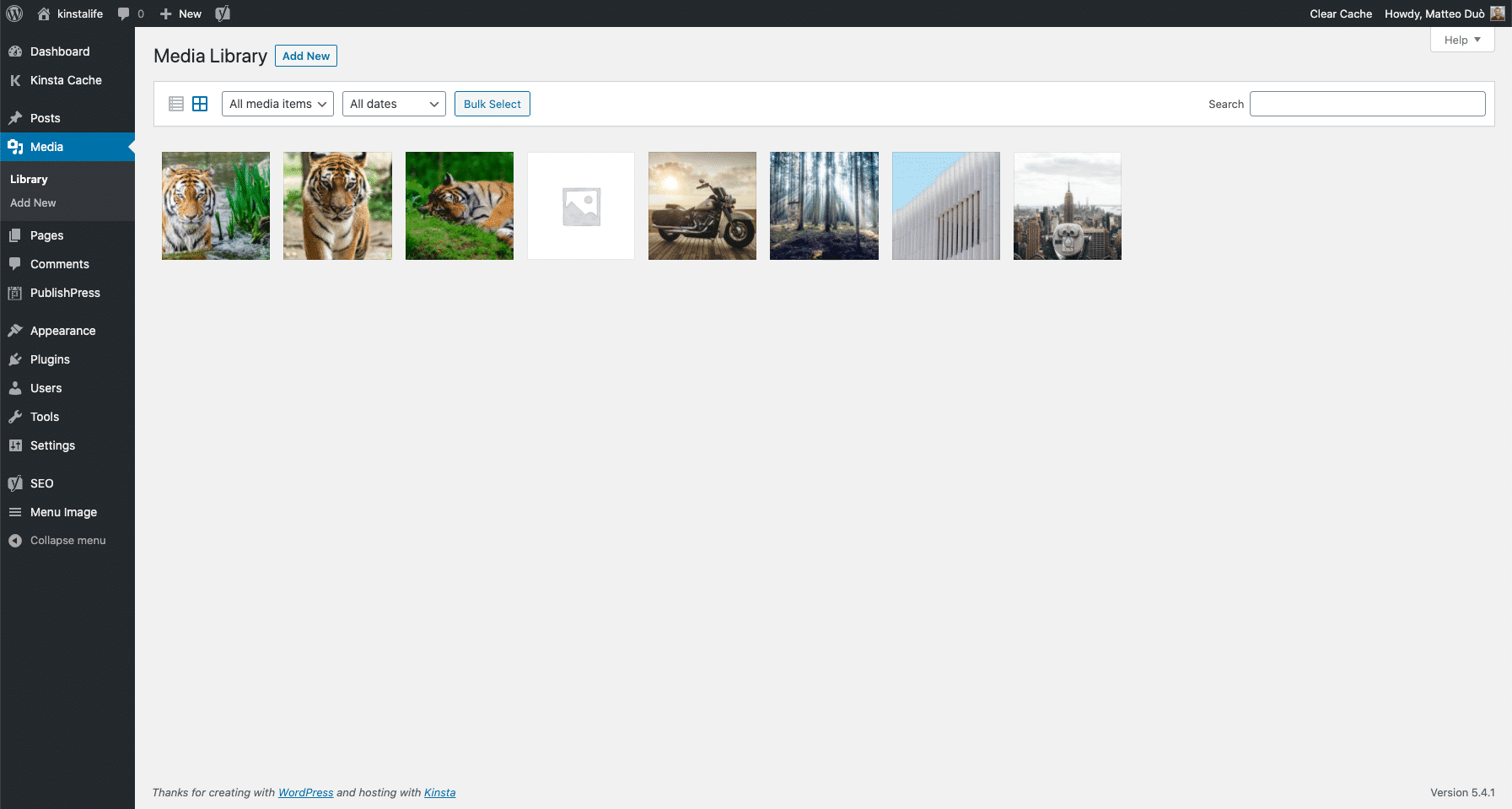
WordPress is capable of hosting a variety of types of media, including:
- Images (.jpg, .jpeg, .png, .gif, and .ico).
- Audio files (.mp3, .m4a, .ogg, and .wav).
- Videos (.mp4, .m4v, .mov, .wmv, .avi, .mpg, .ogv, .3gp, and .3g2).
- PDFs.
- Word documents.
- Excel spreadsheets.
- PowerPoint presentations.
- Adobe Photoshop documents.
Information technology too has some express photo-editing capabilities, so you tin can brand adjustments as needed right from your dashboard.
Unfortunately, WordPress doesn't support webp images out of the box however.
To access your Media Library, merely click on Media in your admin sidebar at whatsoever time:
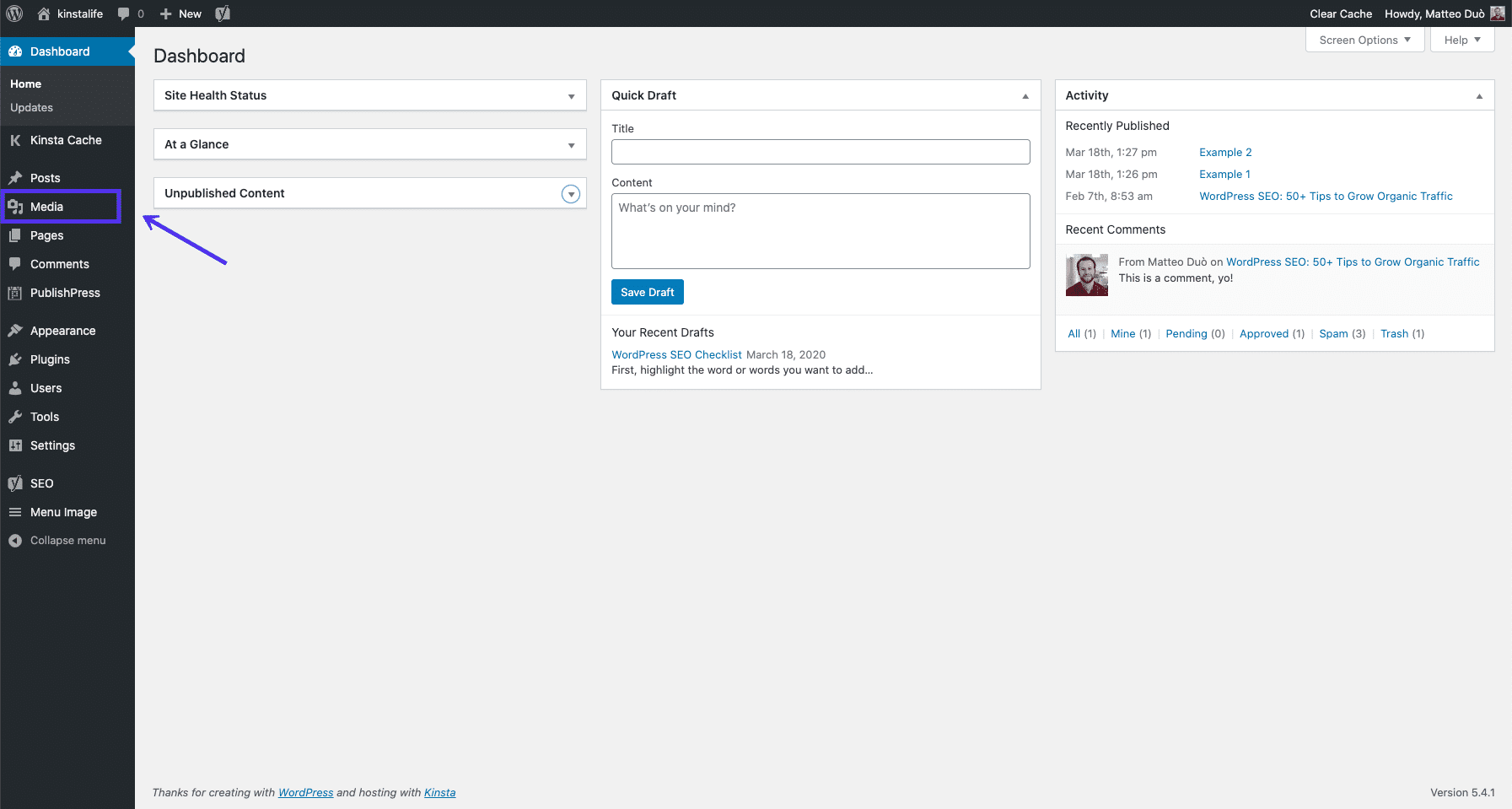
In that location are a few basic options available here.
Kickoff, yous can make up one's mind if yous want to run into your files in a list or grid view past clicking on the relevant icons:
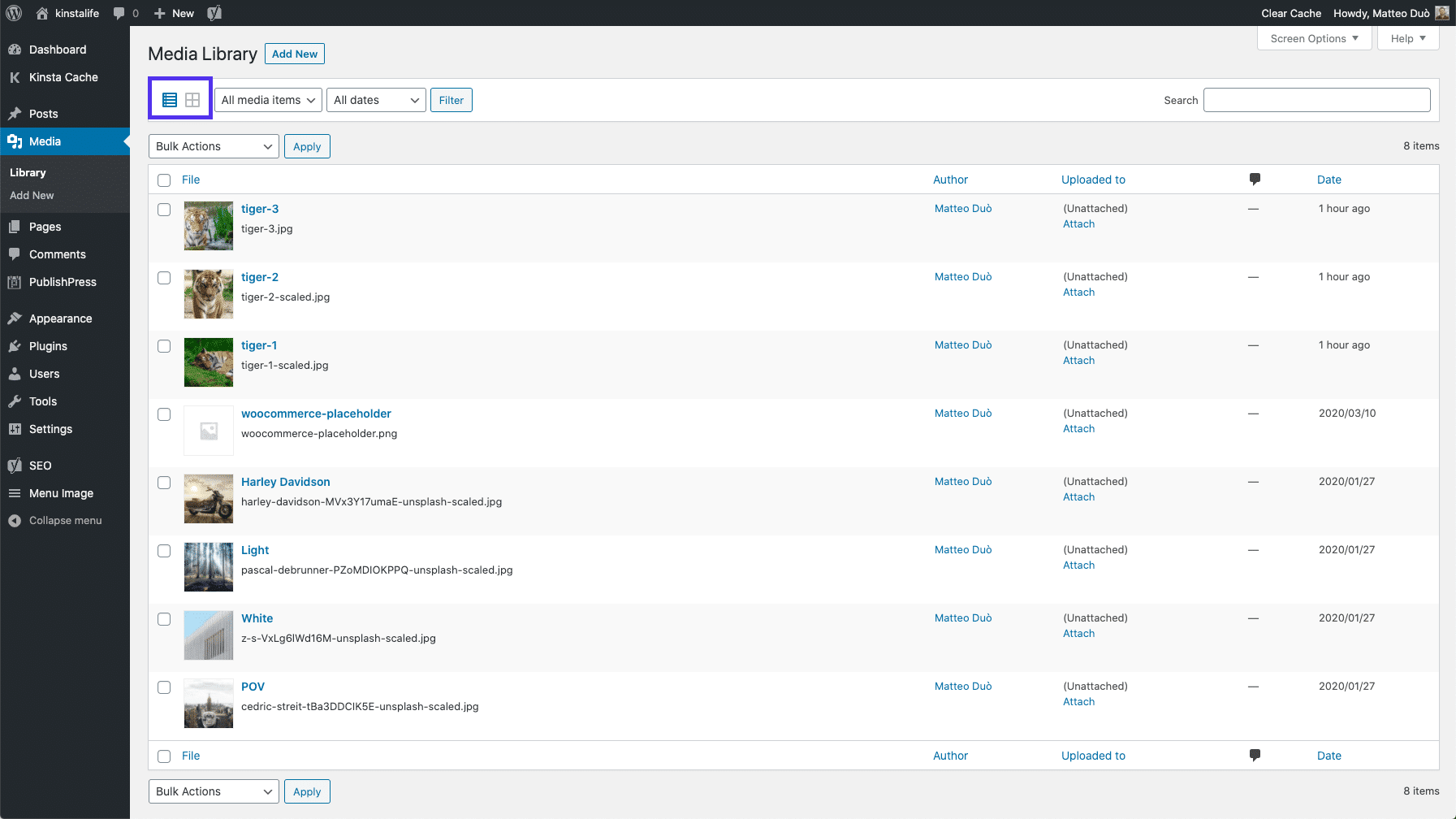
You can also filter your files using the drop-down menus:
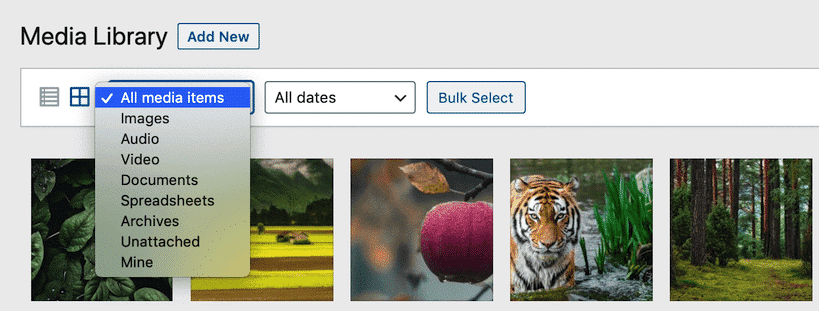
The first menu enables you lot to view your media by blazon, while the second will filter your library'south contents by the dates on which they were uploaded.
You can also use the search bar to wait for specific files by name:

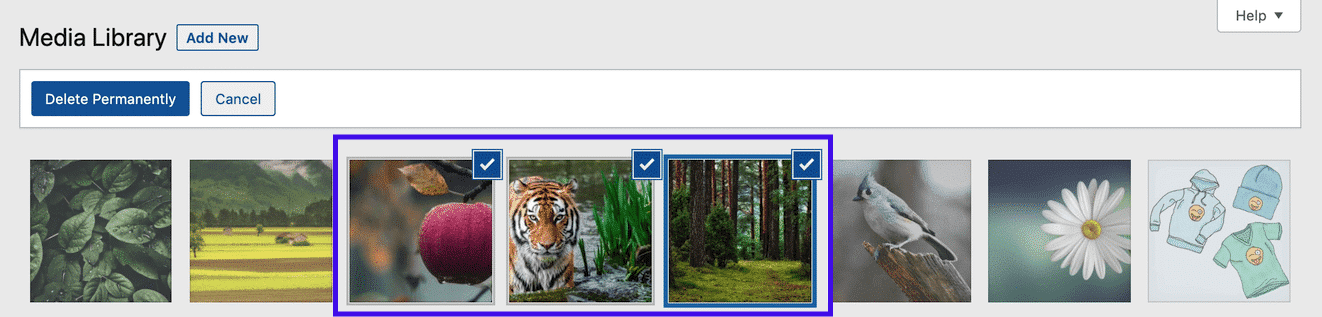
Finally, there's too a Bulk Select button. This feature lets y'all delete several files from your WordPress installation all at in one case:
This covers all of the native functionality available in the WordPress Media Library screen.
Equally you'll see subsequently, there are many modifications you tin can make to heighten information technology. First, however, we need to talk over how to add files to WordPress.
How to Add Files to Your WordPress Media Library
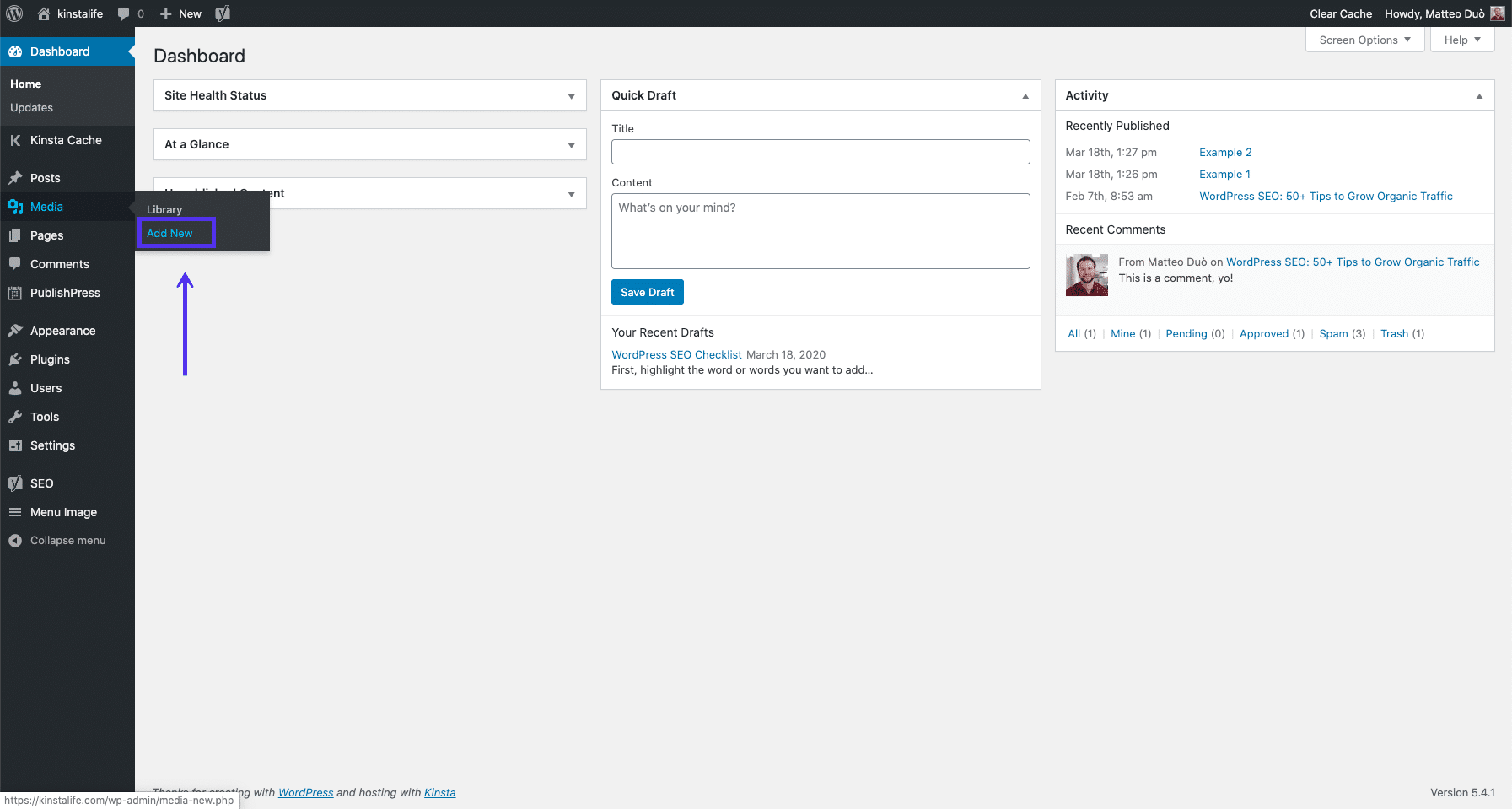
At that place are a few different ways you can add files (e. yard. your site's favicon) to your WordPress Media Library. The first is to navigate to Media > Add New:
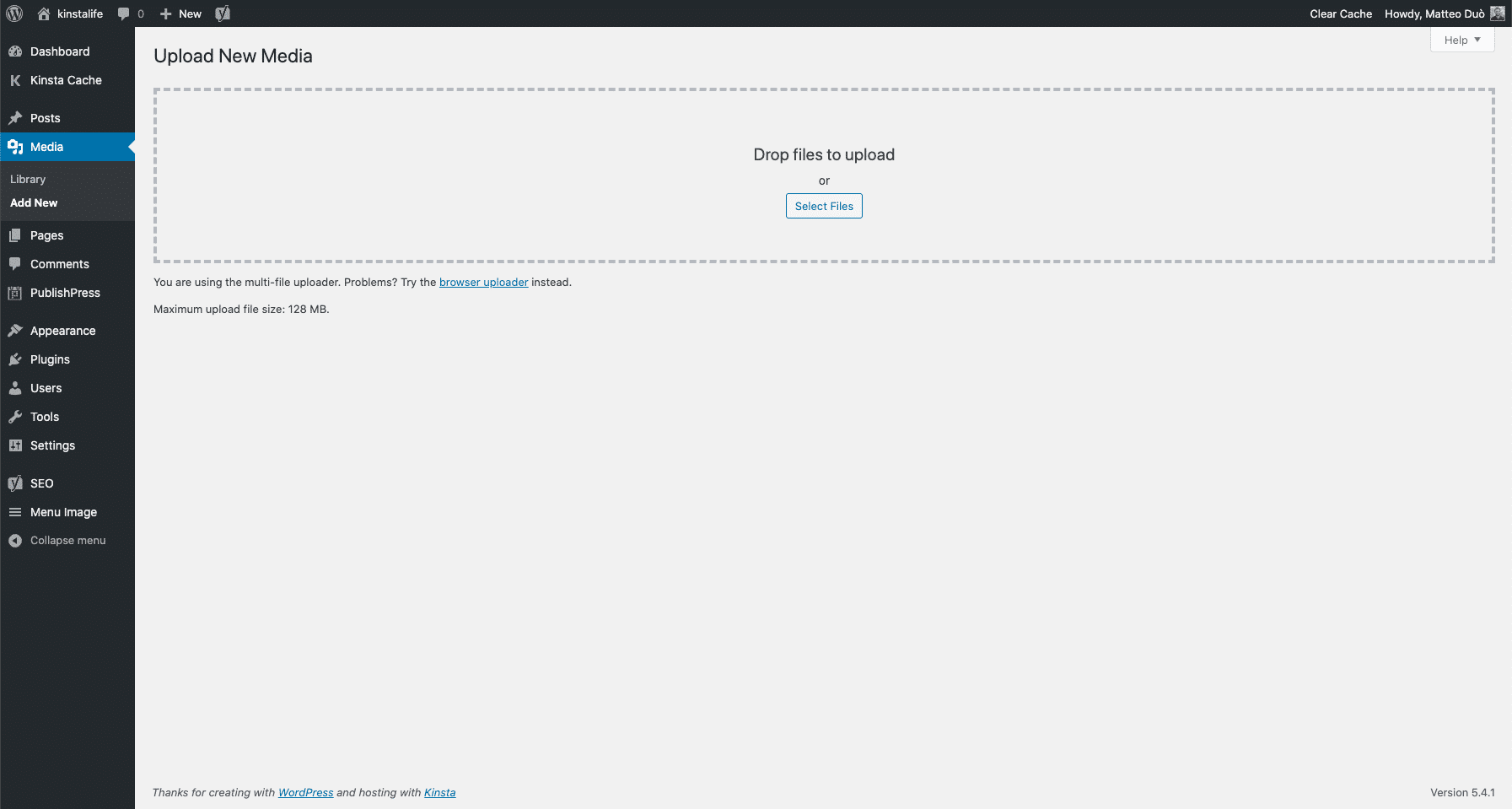
Hither, you can upload files that are saved on your figurer or another device:
You lot can besides add together media directly from the WordPress editor. In the Block Editor, start by calculation the respective block for the type of media yous want to incorporate:
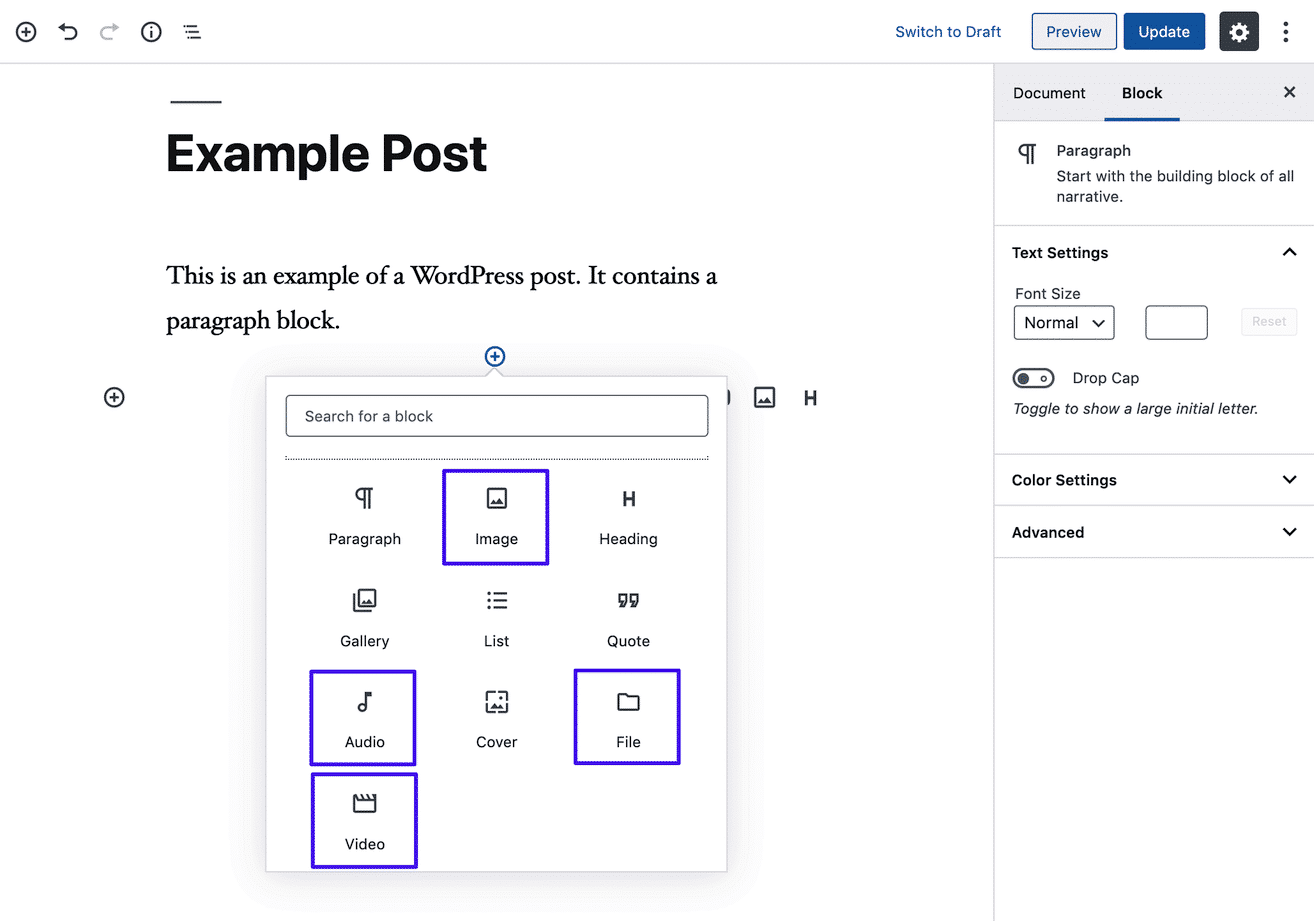
In the resulting placeholder, select Upload and choose a file from your computer:
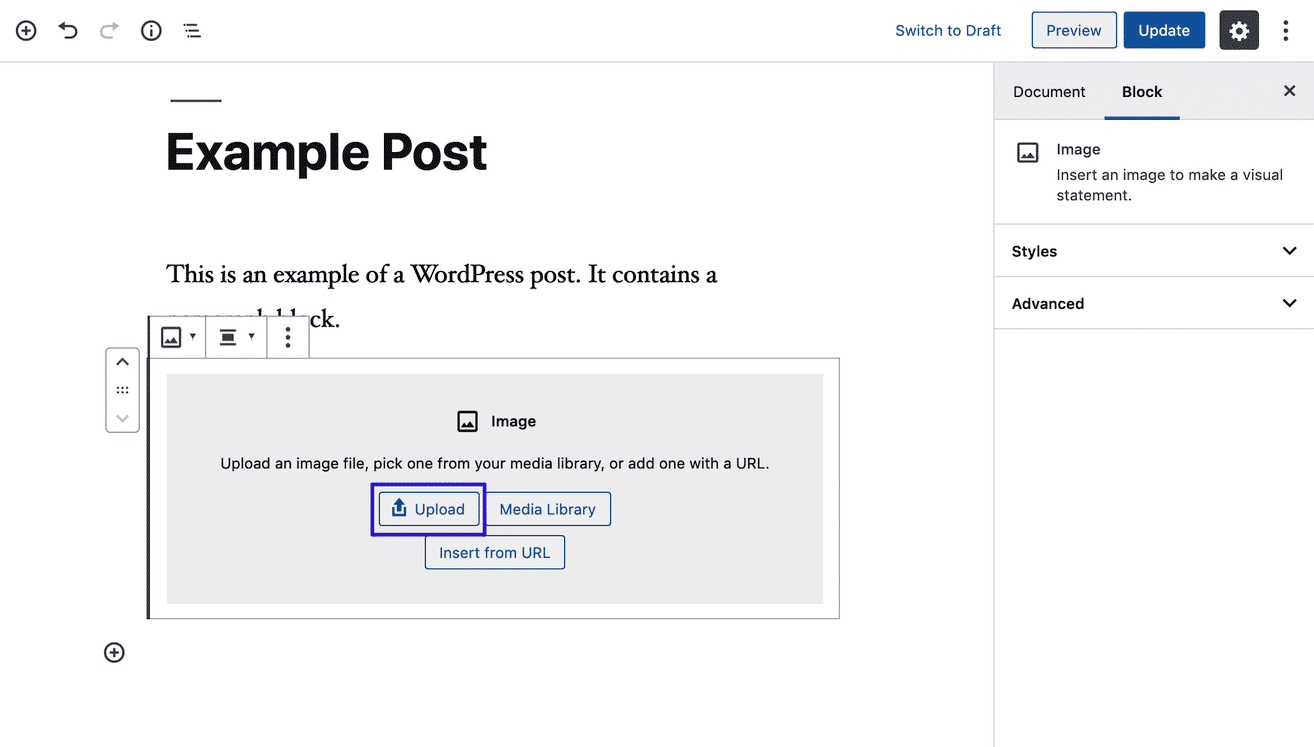
Alternatively, you tin simply drag and drib the file from your desktop into the relevant block.
In the Archetype Editor, y'all'll need to click on the Add Media button:
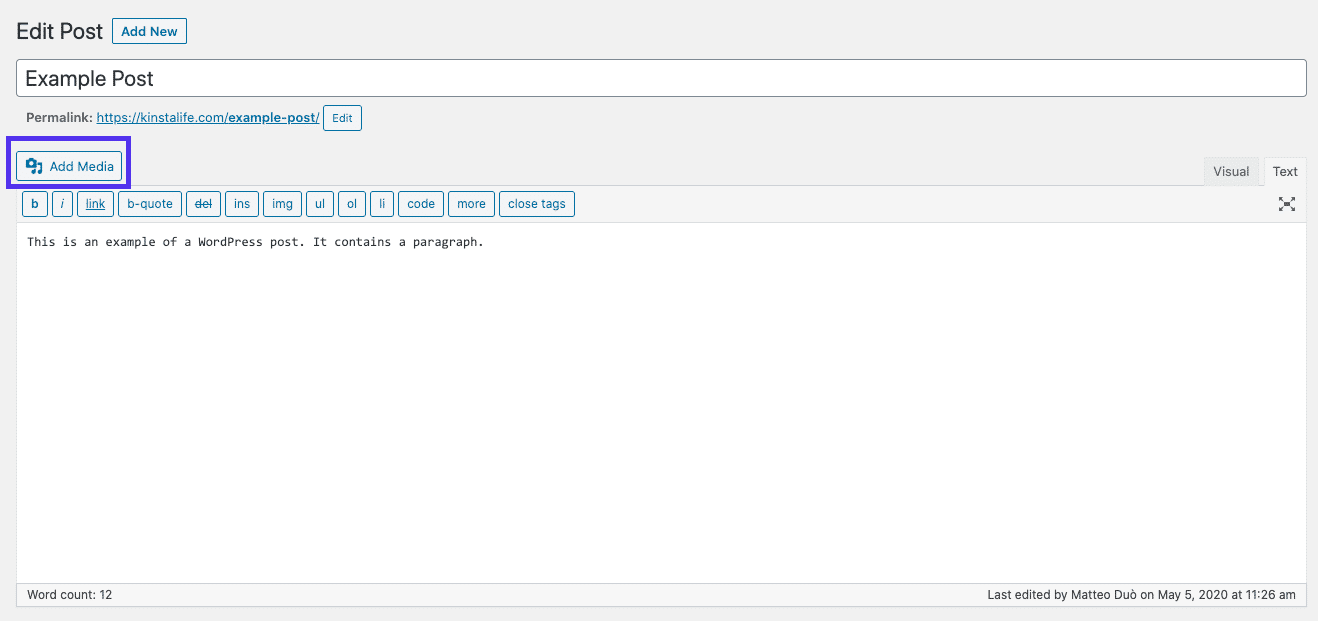
Then navigate to the Upload tab and select a file from your estimator:
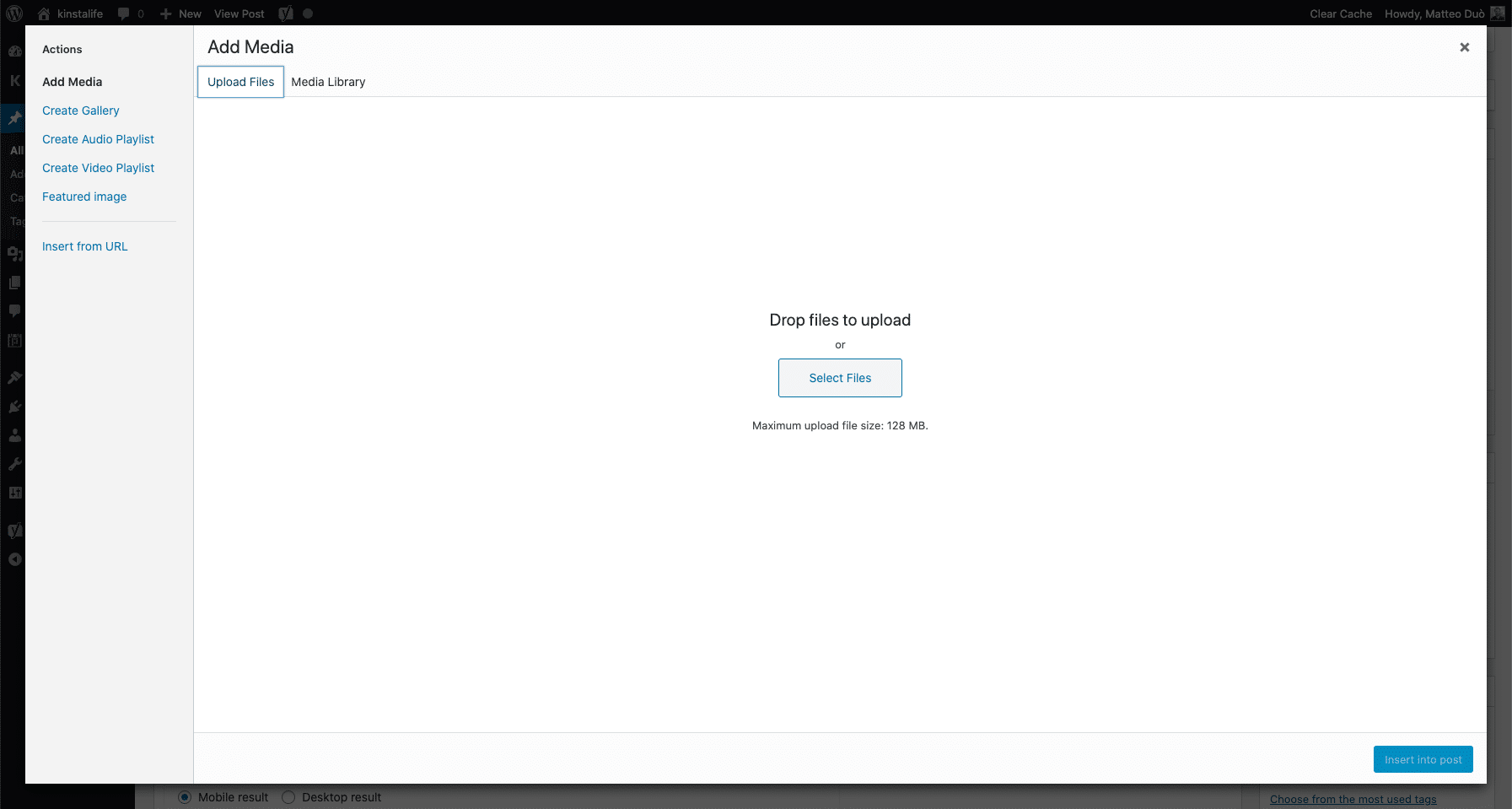
You can also elevate and drop files from your desktop directly into the editor at any time.
In some cases, you may notice that yous need to manually upload media files to your WordPress site via FTP. You lot tin can do this using a client such every bit FileZilla.
Once you connect to your server, navigate to wp-content > uploads:
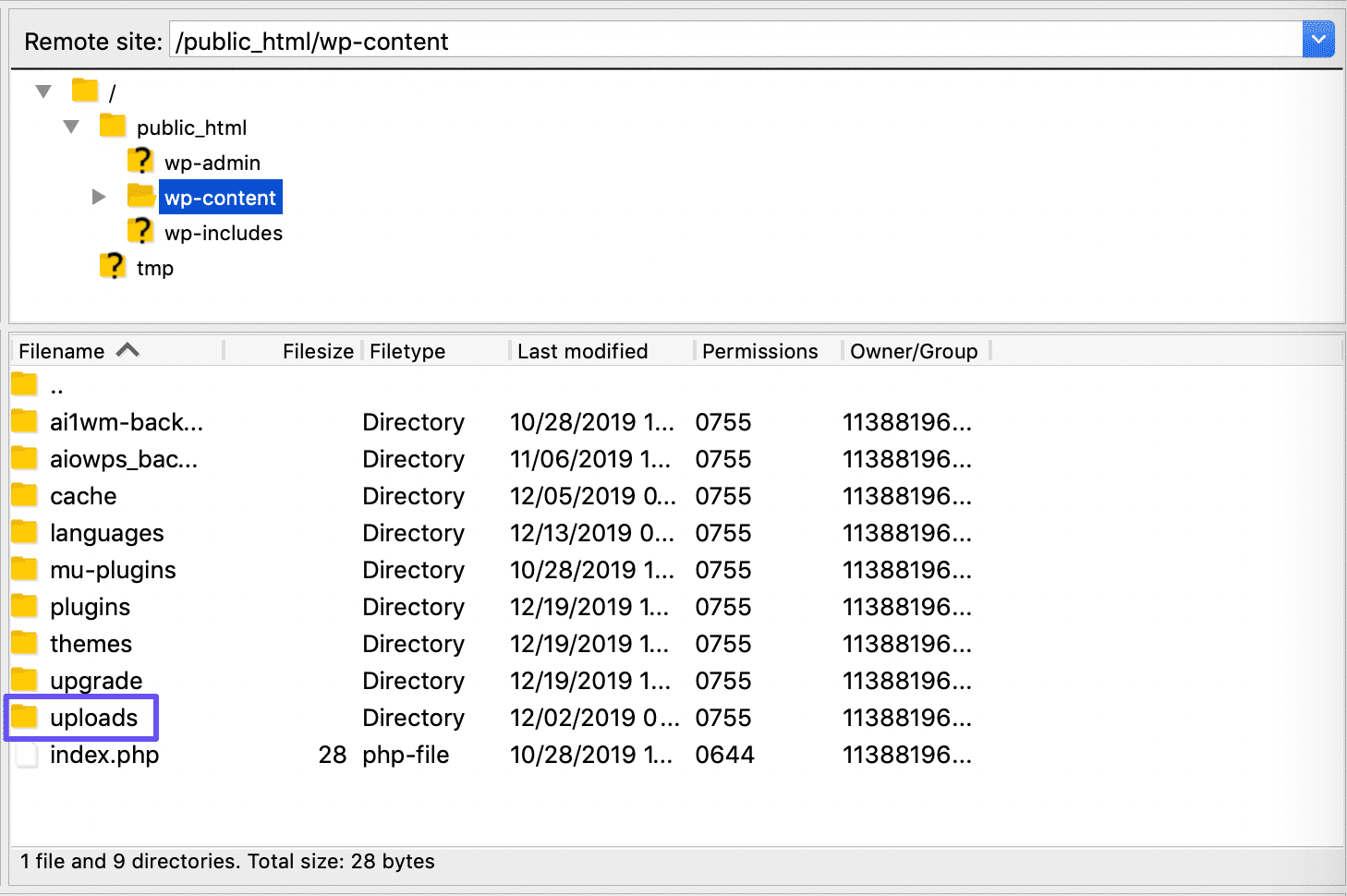
Upload files to this directory to add them to your Media Library.
Downloading Content from the WordPress Media Library
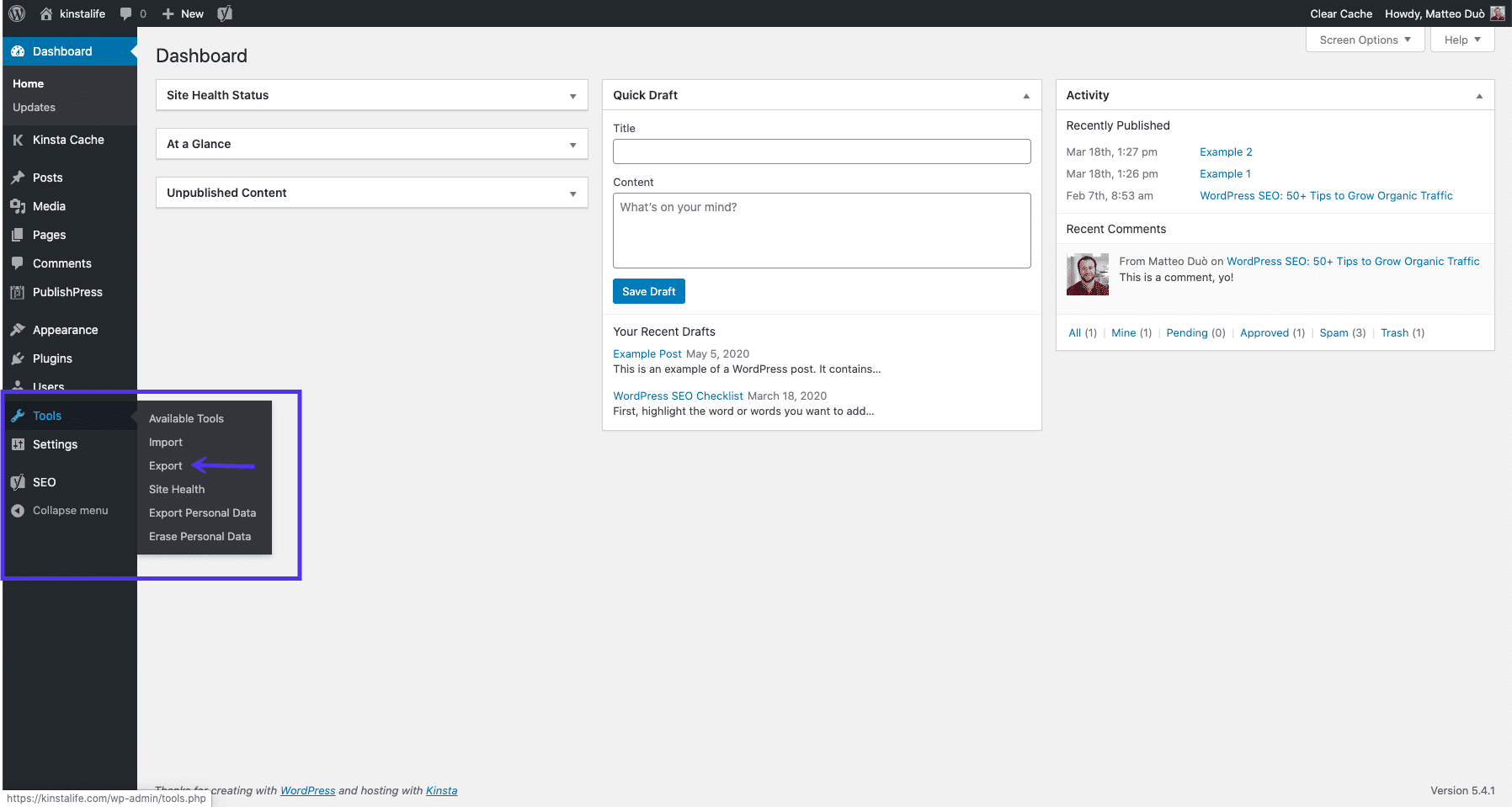
In some circumstances, you may need to download files from your Media Library onto your estimator. WordPress enables y'all to exercise this natively by navigating to Tools > Export:
Then select the Media option. If you only need files that were uploaded within a specific fourth dimension frame, you can use the dropdown menus to specify your request:
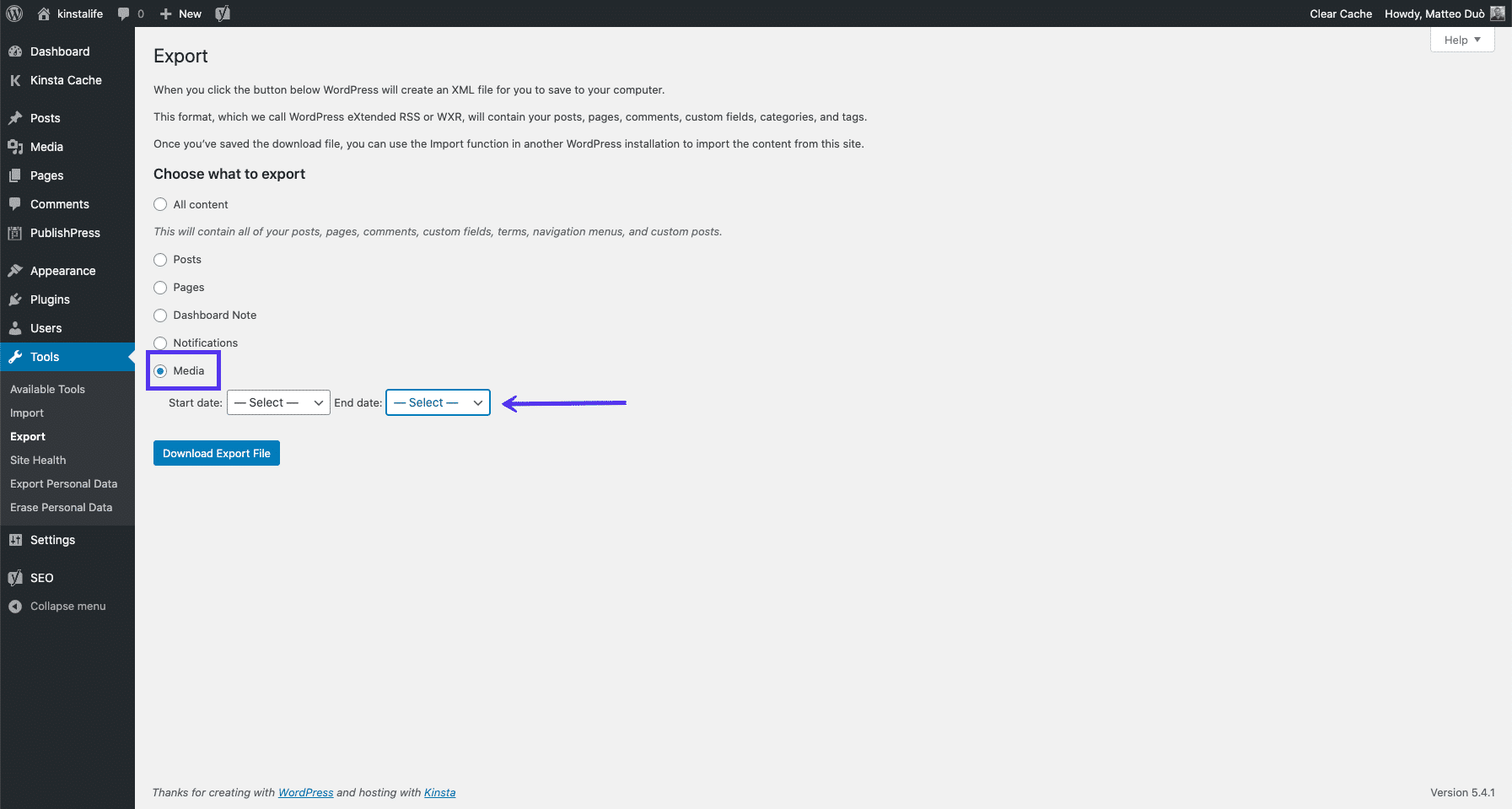
Finally, click on the Download Export File button. This volition download the relevant media files to your figurer.
How to Edit Images in the WordPress Media Library
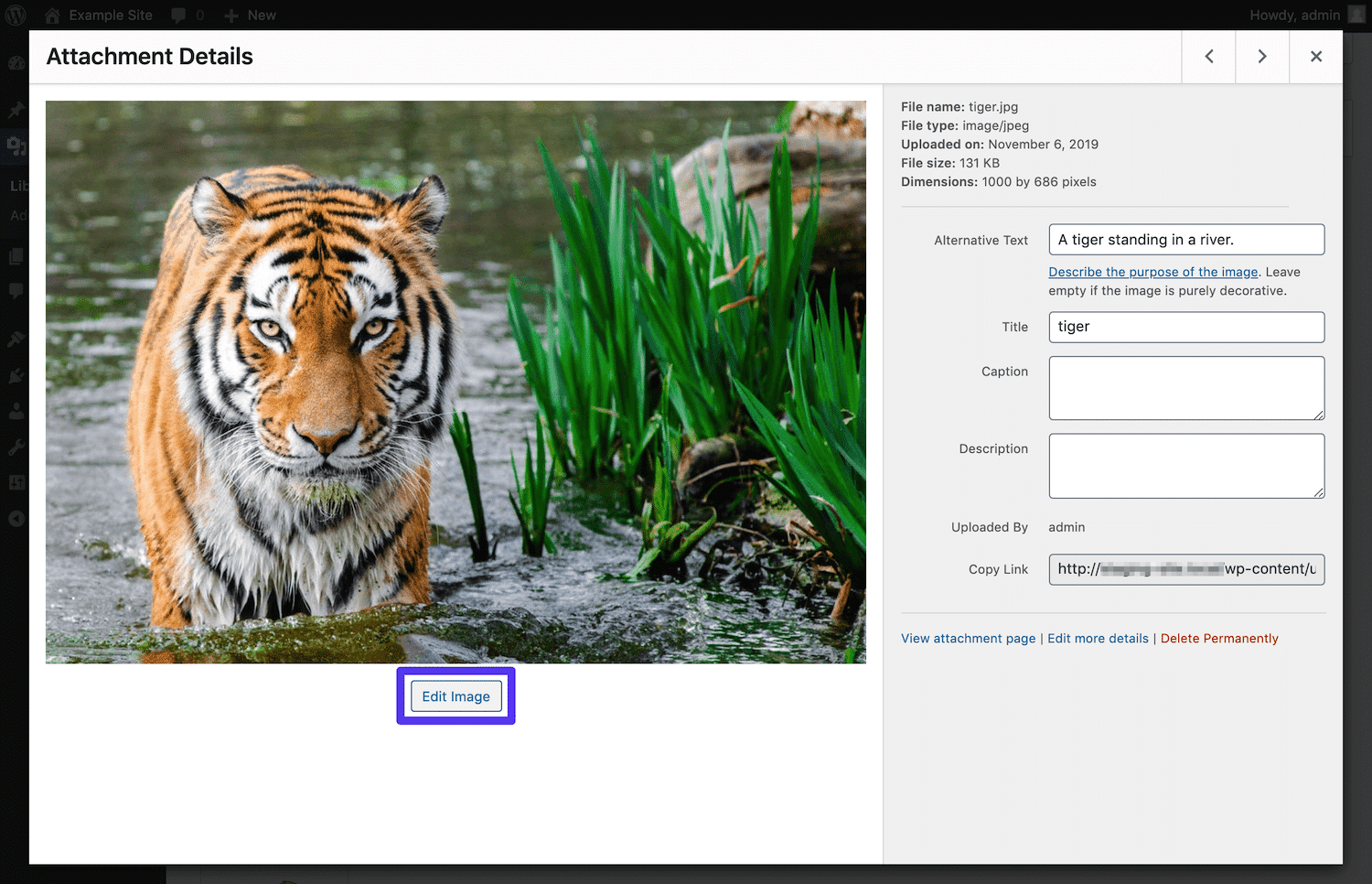
Every bit we mentioned earlier, WordPress has a few native prototype editing features. To access them, navigate to your WordPress Media Library and select the file you lot desire to edit. And then, click on the Edit paradigm button:
This volition open the image editor:
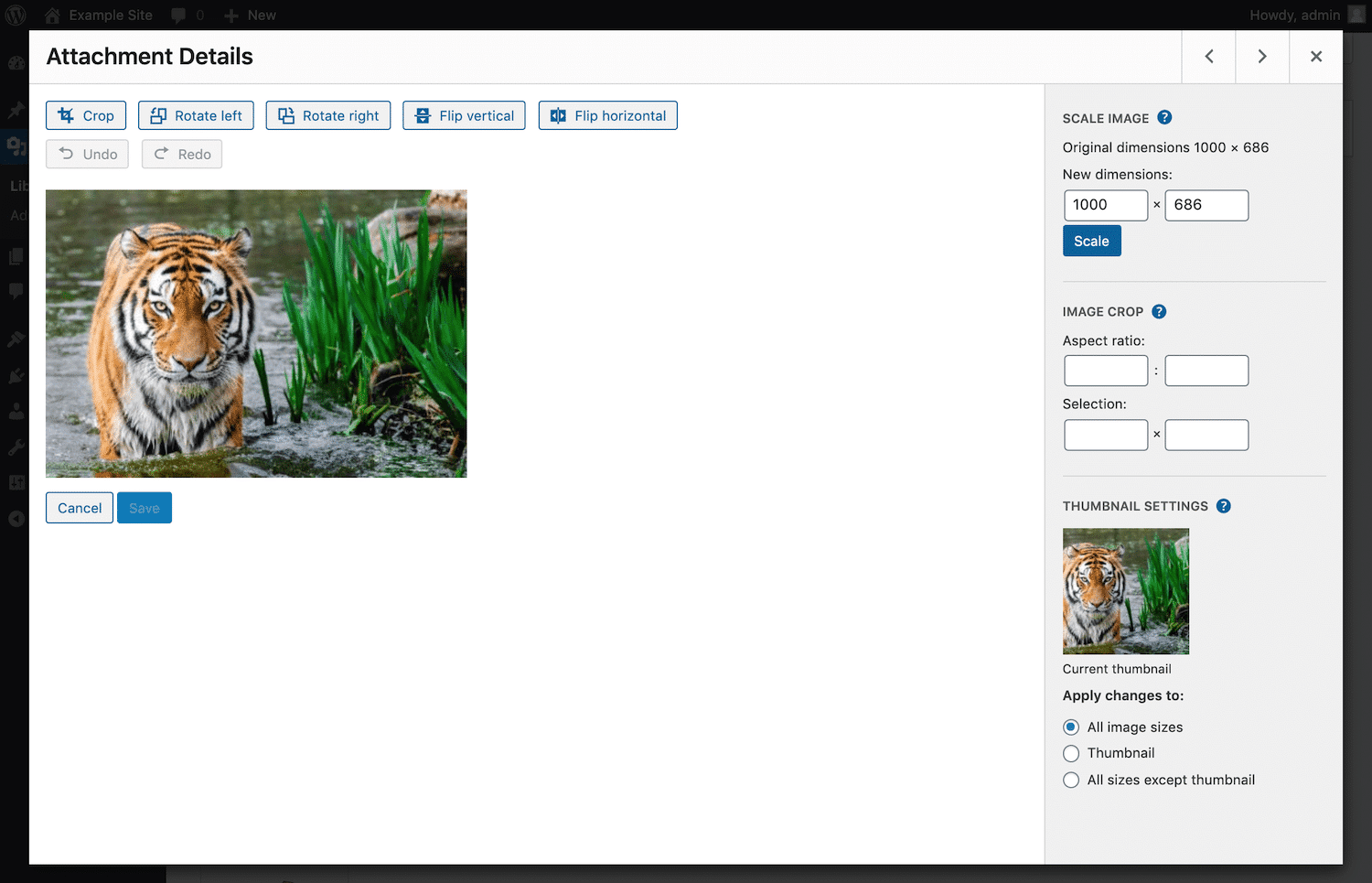
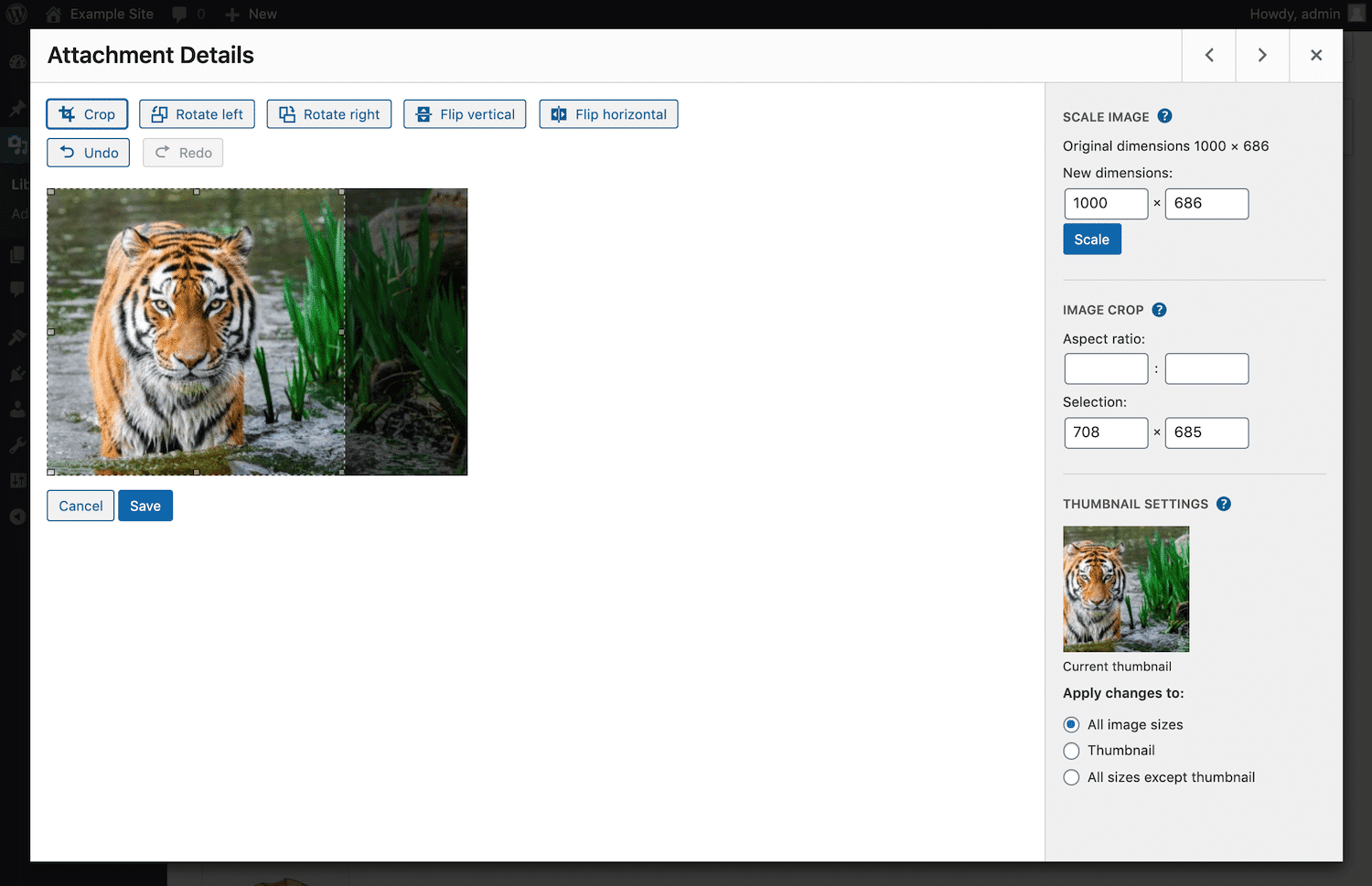
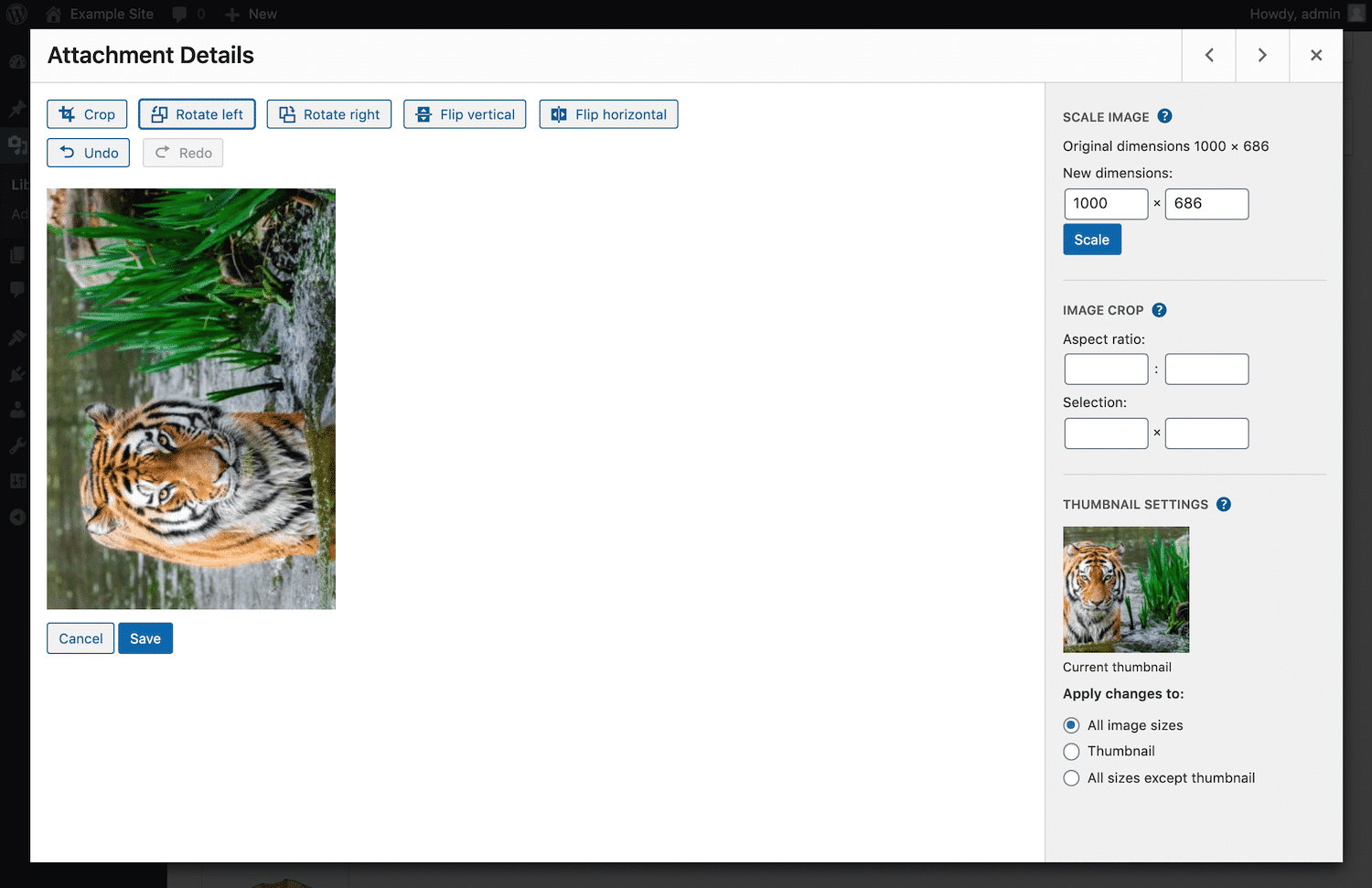
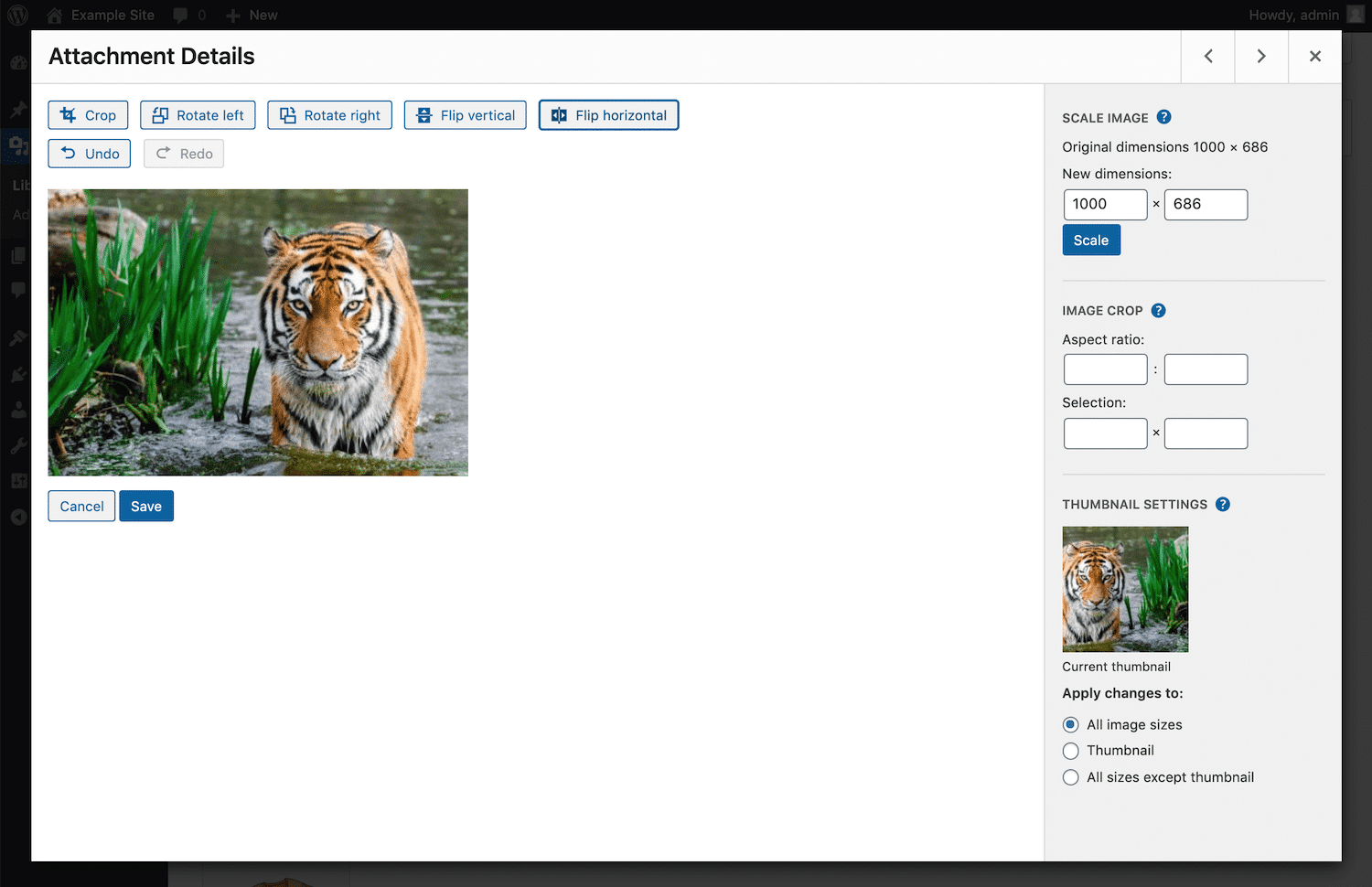
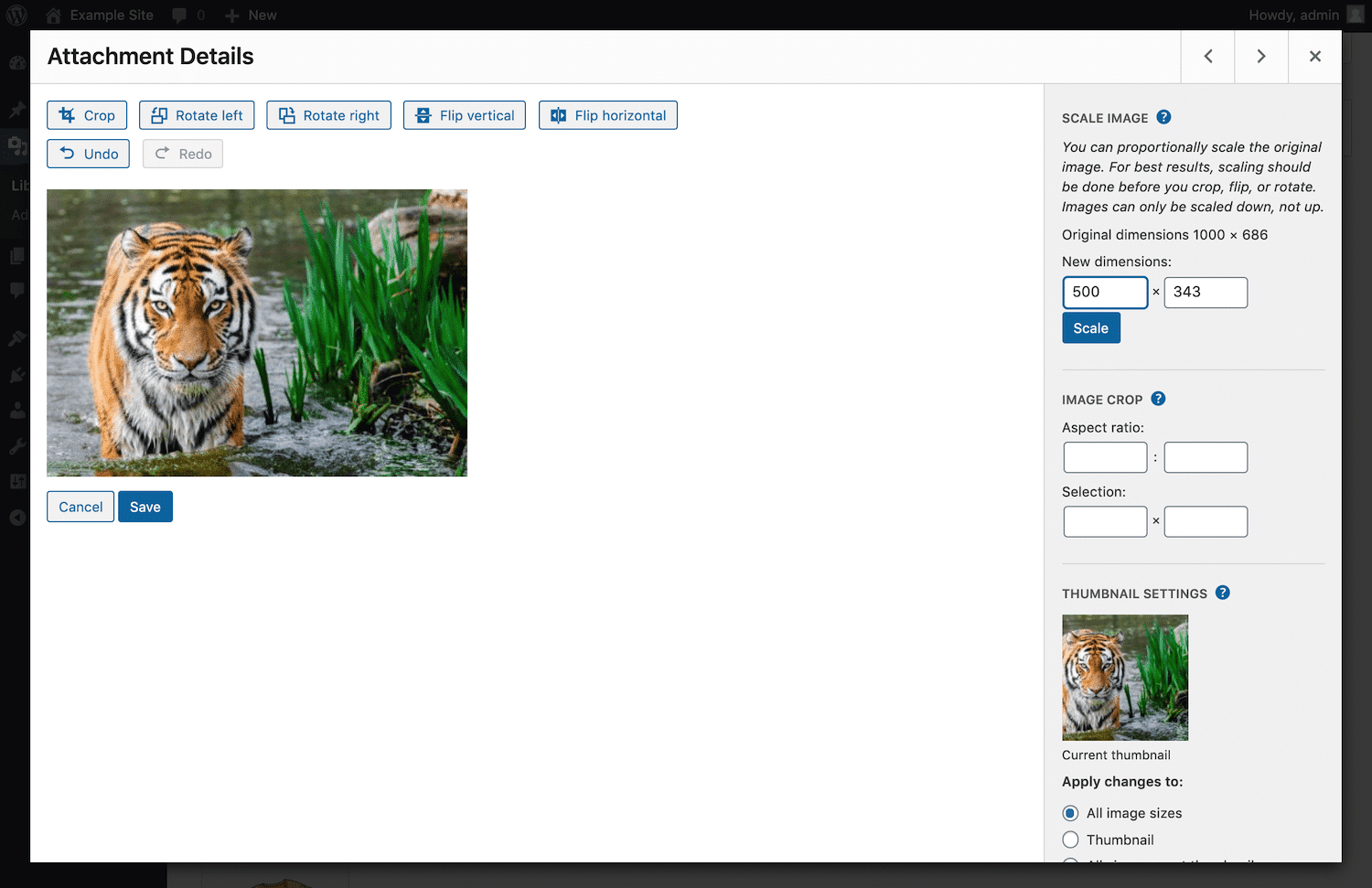
In that location are five basic edits you lot can brand:
Cropping enables you to cut sections of the prototype out:
Rotating the image volition turn it either counterclockwise or clockwise past xc degrees:
Flipping the prototype volition reverberate it either vertically or horizontally:
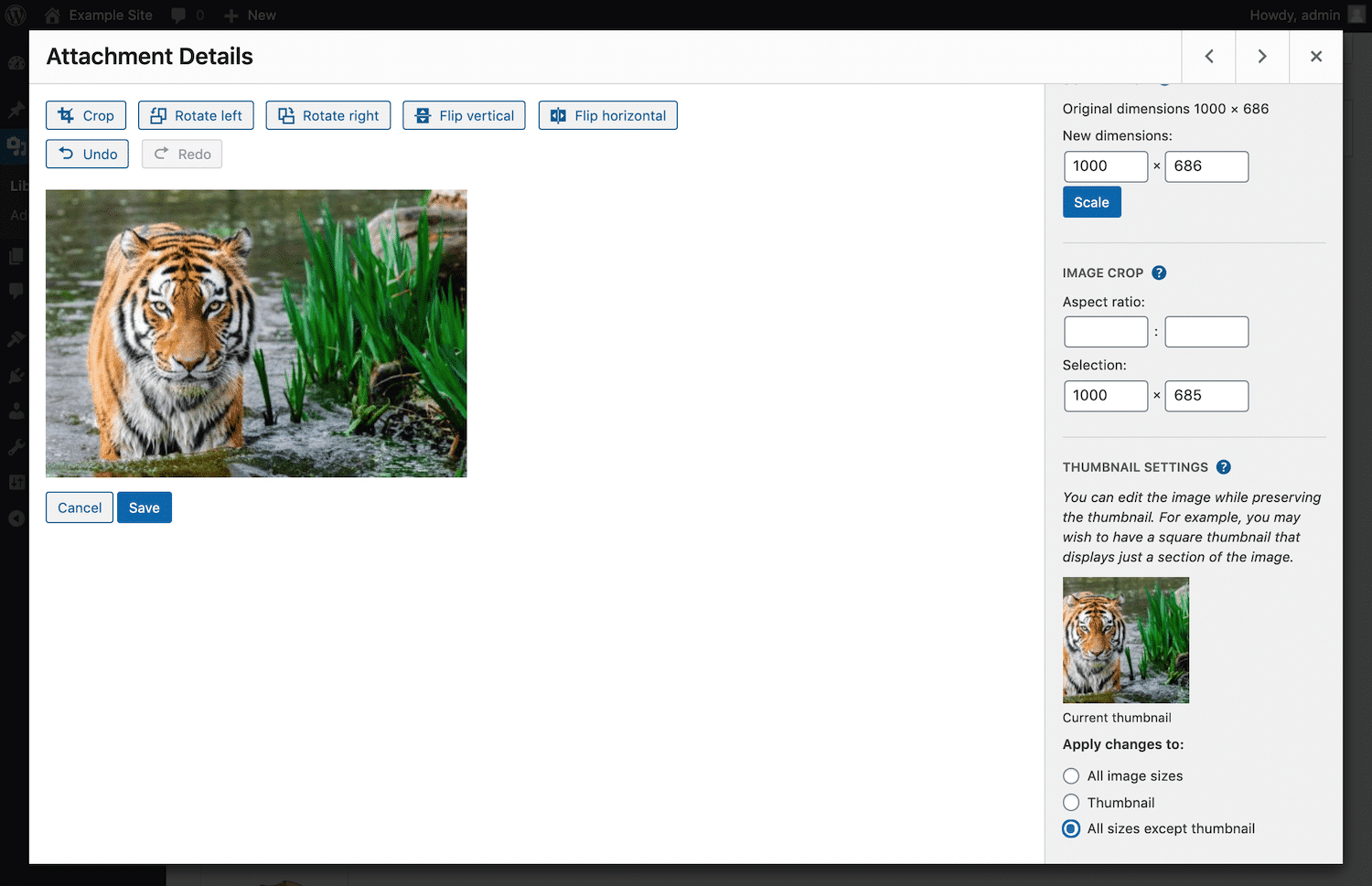
The other 3 settings are in the sidebar. The first enables yous to modify the size of the image by scaling information technology. Merely enter your desired superlative or width, and the other field will auto-populate. And so click on the Scale button:
Information technology's important to note that resizing images in WordPress can sometimes negatively bear upon their quality.
Additionally, you can only have big images and scale them down. You can't scale images up to a larger size!
To crop your image so that it has a specific attribute ratio or dimensions, you can apply the Attribute Ratio and Choice fields nether Paradigm Ingather:
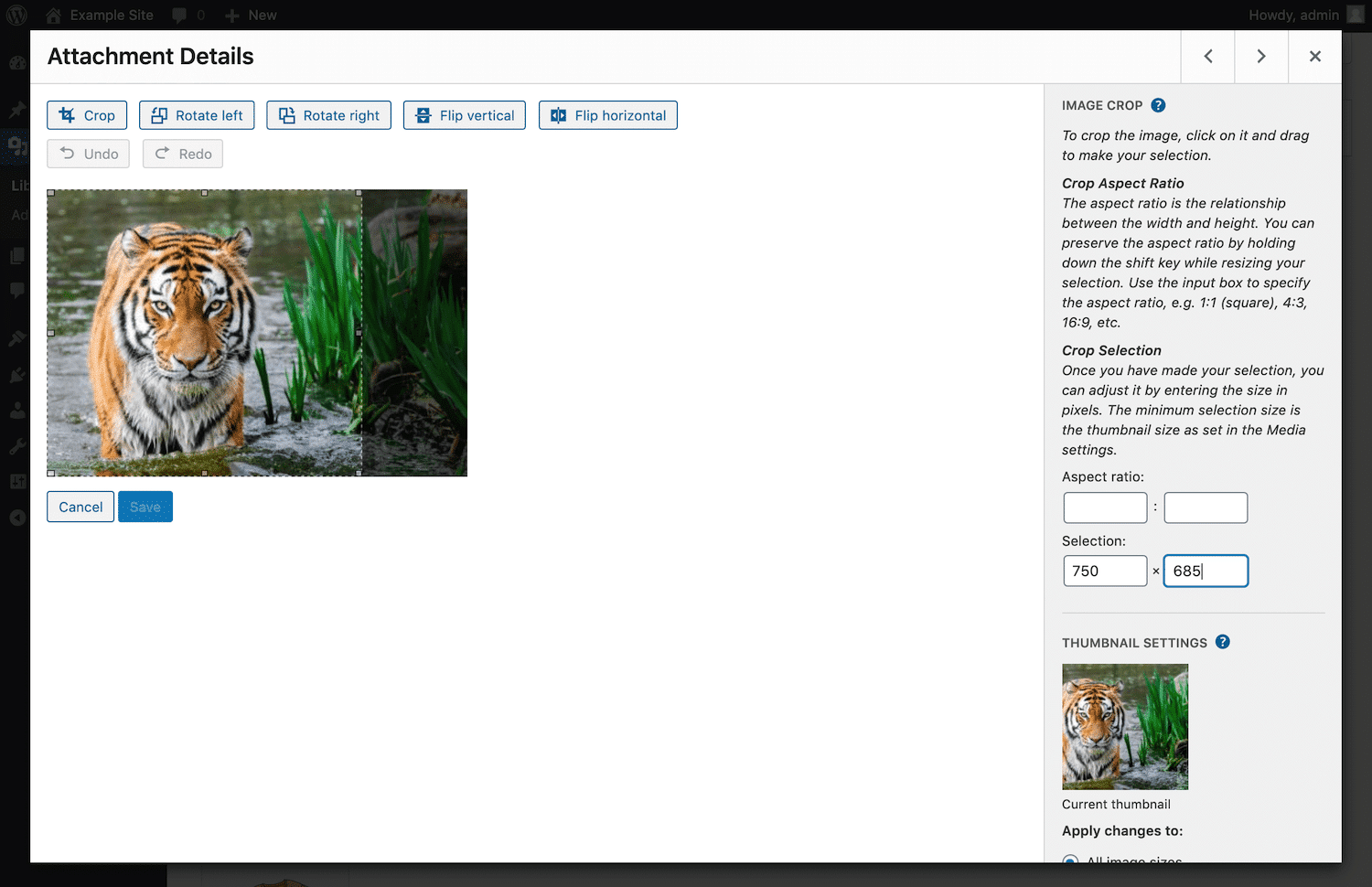
Finally, if y'all wish to preserve the existing image thumbnail, you lot tin can do and so using the Thumbnail Settings. Merely select the radio push button for whichever version of your image y'all desire to apply changes to:
WordPress' default image editing is useful but limited. It won't replace any software you might apply for more extensive modifications, particularly if yous're running a photography site or photoblog.
Understanding WordPress Media Library Errors
Unfortunately, WordPress errors occur. And the WordPress Media Library is no exception.
Subscribe Now
One issue that commonly shows up is an unspecified "HTTP mistake" that tin can appear when yous're uploading a new file from within the editor:
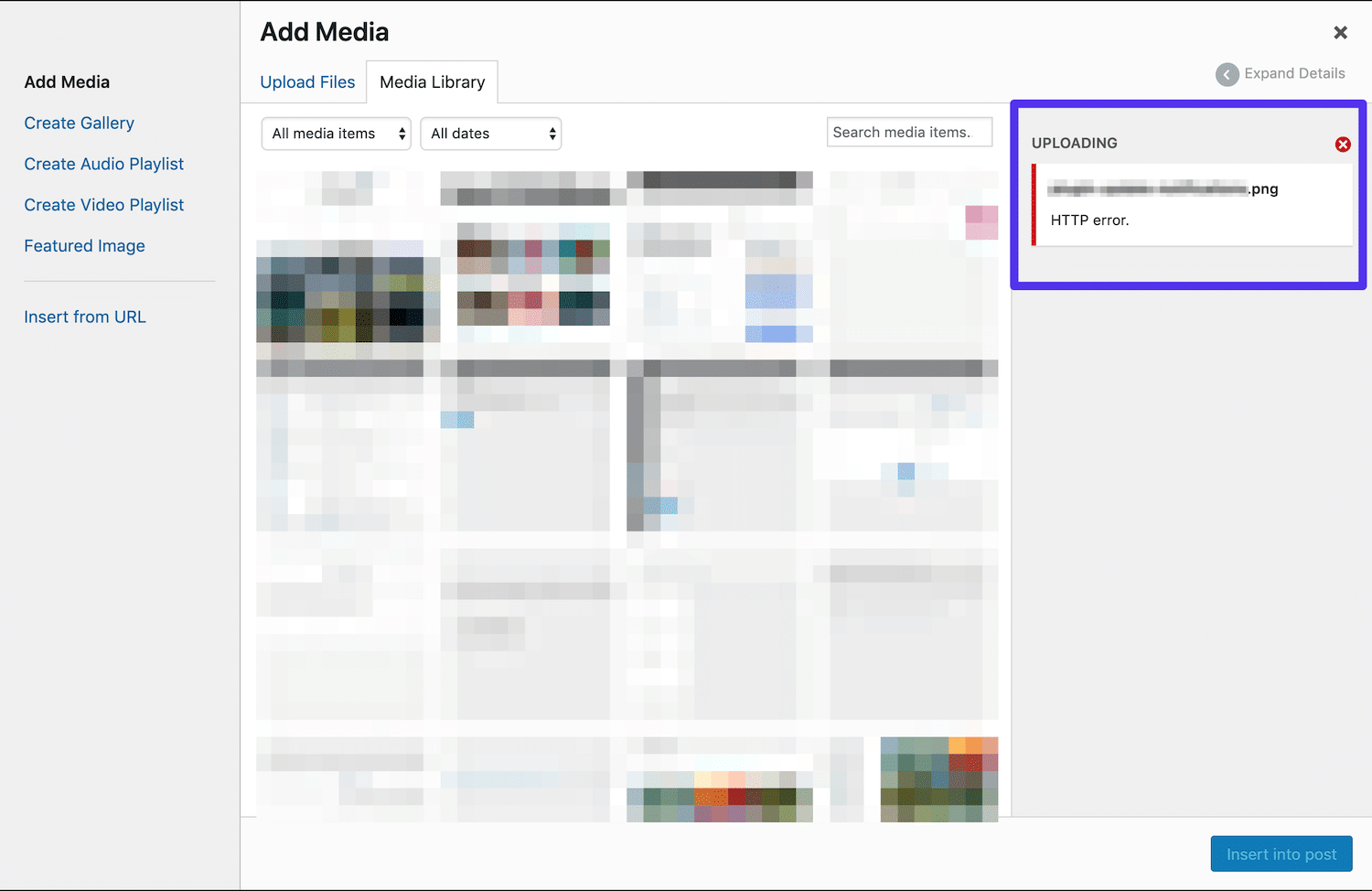
Ordinarily, you tin can but wait for this fault to disappear and attempt your upload again afterward a few minutes. If the HTTP fault reoccurs, information technology may be that your WordPress session has expired. You'll demand to log in again and so retry your upload.
Another problem some users face is the Media Library failing to load. This is often due to a conflict with your plugins and/or theme. To troubleshoot this error, endeavor deactivating all of your plugins and switching to a WordPress default theme.
If your Media Library loads properly again, you lot'll need to troubleshoot the plugin conflict farther in gild to resolve the issue permanently.
Sometimes you tin run across the "Upload: Failed to Write File to Disk" mistake when you offset uploading your files through the media library. Usually, this problem occurs when your upload directory is gear up to Not Writable. You can check your filesystem permissions via WordPress'due south Site Health tool.
Long-Term Media Library Management
So far, we've focused exclusively on WordPress' native functionality when it comes to the Media Library. Nonetheless, equally you lot utilize this feature over time, y'all'll likely encounter some trouble that requires help from external solutions.
For case, the more than files you lot add together, the more disorganized your WordPress Media Library will become. Aside from the search and filter options discussed towards the starting time of this post, WordPress doesn't provide much help for dealing with unruly volumes of media.
There are, however, a few plugins that enable yous to adjust your media files into folders.
WordPress Media Library Folders plugin is the nigh popular option:

In addition to enabling you to create media file folders, this plugin as well integrates with MaxGalleria to let you create paradigm galleries directly from the Media Library:

Upgrading to WordPress Media Library Folders Pro provides boosted integration with the NextGEN Gallery plugin and Avant-garde Custom Fields. It too enables yous to create categories and tags to further organize your files.
Another functionality WordPress lacks is the ability to replace media files with new versions. Since these types of files can be quite big, you don't want to simply keep adding new ones whenever yous demand to update your content.
This means that after uploading a new file, y'all'll need to locate the former version and delete it. You can salve yourself some time past directly replacing onetime images with Enable Media Supercede by ShortPixel:
With this plugin, yous tin can as well replace all links pointing to the old file. This is helpful for avoiding cleaved media throughout your site.
Real Media Library is another folders and files director worth checking out to brand your file management a breeze.
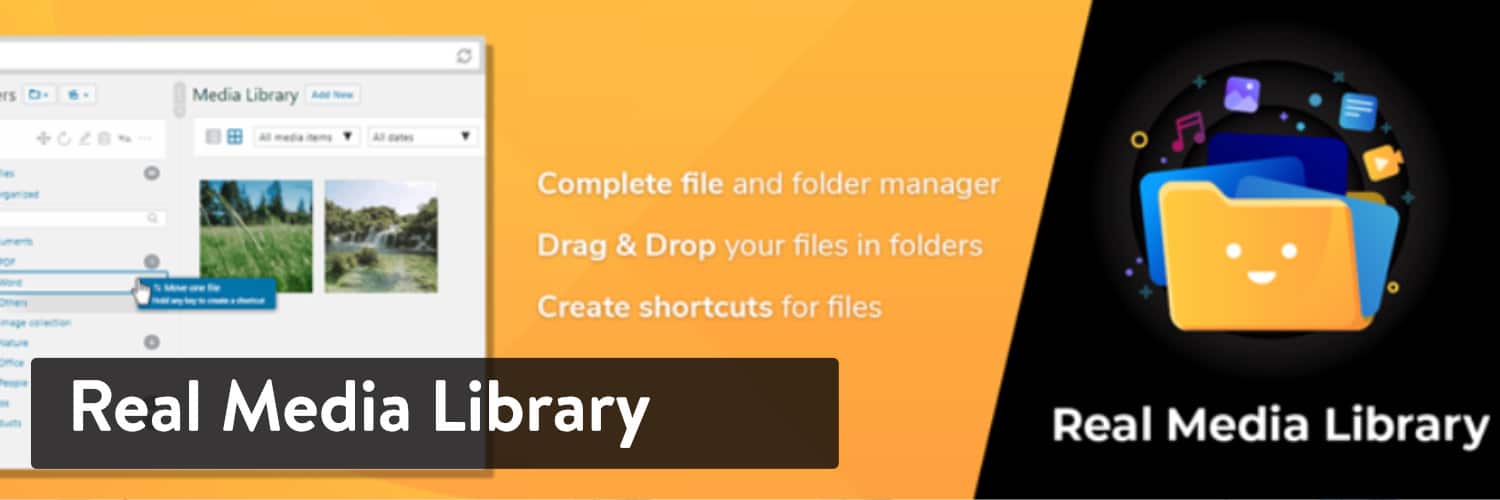
Cheers to it, you're able to take care of enough of files such every bit pictures, videos, and documents direct in WordPress. Nice thing to know: Real Media Library is available in 12 languages. If the gratis version isn't plenty for your needs, they also provide a buy the PRO version with more than features.
4 Handy WordPress Media Library Hacks
The WordPress Media Library can handle most of the common requirements of a site ambassador. Withal, WordPress provides a number of functions and hooks that enable users to heighten specific features of the Media Library, without the apply of third-political party plugins. Allow's dive into these functions and hooks with four practical examples.
i. Add Custom Metadata to Attachment Post Types
Whatsoever time you lot upload a media file, WordPress generates an attachment post type.
Just like any other post type, attachments are registered in the wp_posts table, and their respective metadata can be plant in the wp_postmeta table in your database:
The wp_posts table stores information that includes post_content (attachment description), post_excerpt (attachment caption), post_author, post_title, post_status, and post_mime_type.
The wp_postmeta table stores whatsoever kind of metadata, such as the attached file URL, image dimensions and mime types, and Exchangeable Image File format (EXIF) and International Press Telecommunication Council (IPTC) metadata.
You may occasionally need to add custom metadata to attachments, such as the proper name of the author of a certificate, an associated URL, or the location where a photograph was taken. Adding meta fields to attachments is a chip unlike from adding meta fields to posts, and requires specific hooks and functions.
Beginning, you'll demand to add all necessary custom fields to the Edit Media screen. You can accomplish this task by filtering the available attachment fields through the attachment_fields_to_edit filter in wp-admin/includes/media.php:
function media_hacks_attachment_field_to_edit( $form_fields, $post ){ // https://codex.wordpress.org/Function_Reference/wp_get_attachment_metadata $media_author = get_post_meta( $mail->ID, 'media_author', true ); $form_fields['media_author'] = array( 'value' => $media_author ? $media_author : '', 'label' => __( 'Writer' ) ); return $form_fields; } add_filter( 'attachment_fields_to_edit', 'media_hacks_attachment_field_to_edit', 10, 2 ); The part has two arguments: the $form_fields array of form fields and the $post object. Offset, get_post_meta retrieves the existing 'media_author' value, then a 'media_author' element is added to the $form_fields array.
Finally, the callback returns $form_fields (meet the lawmaking on Gist).
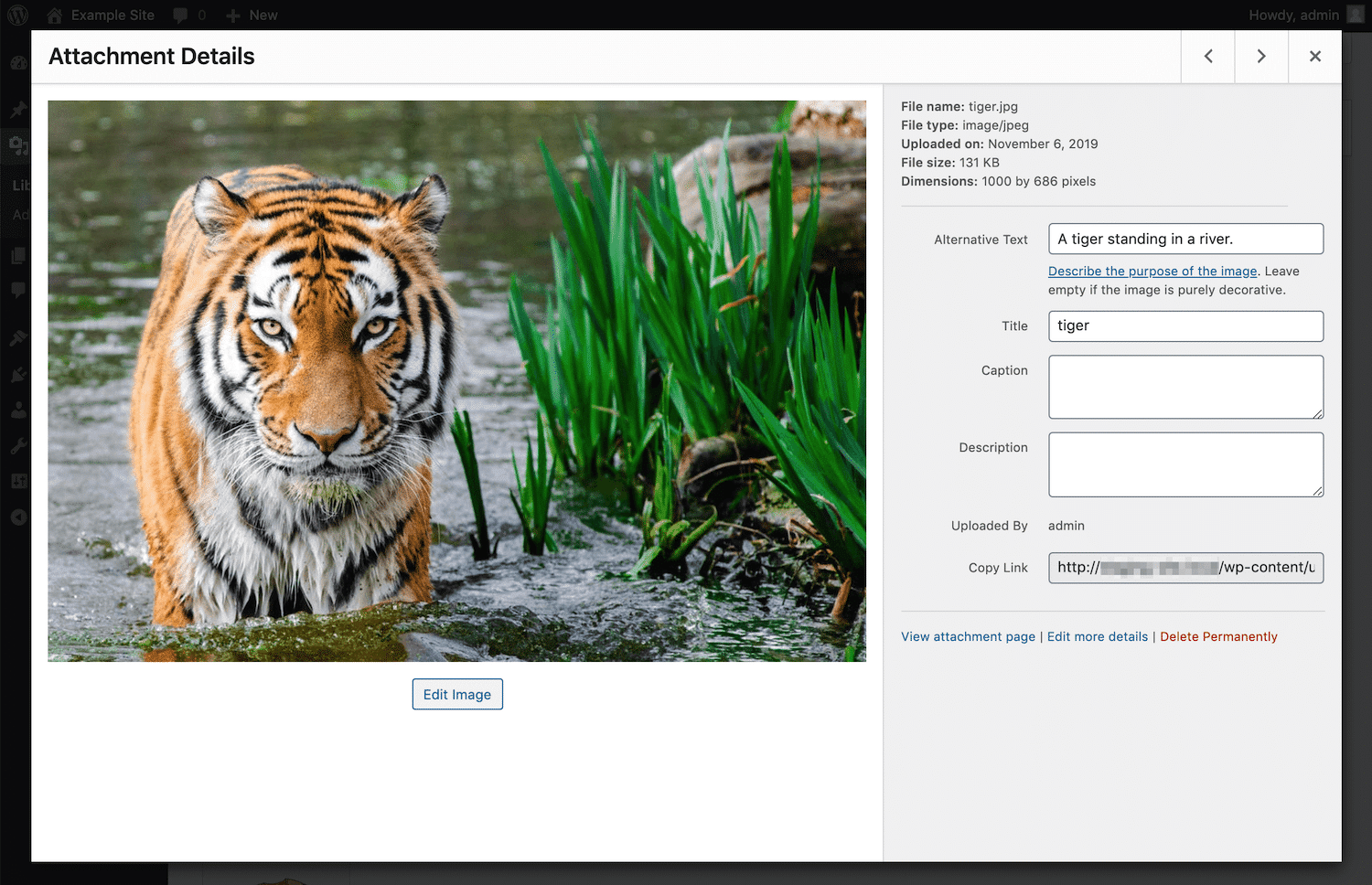
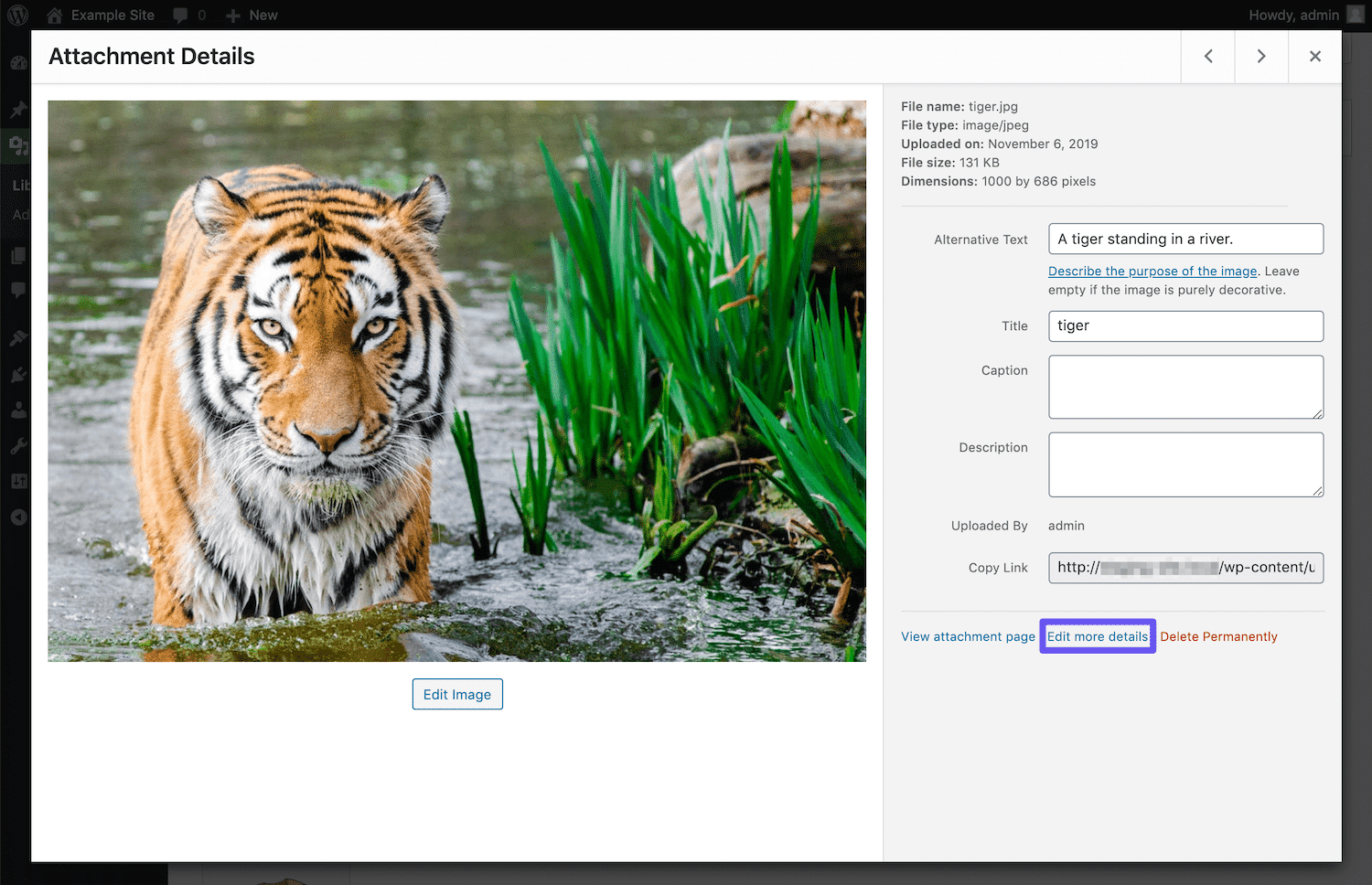
This will display a new field on the Edit Media folio, which you can access past selecting the relevant image from your Media Library and clicking on the Edit more than details link:
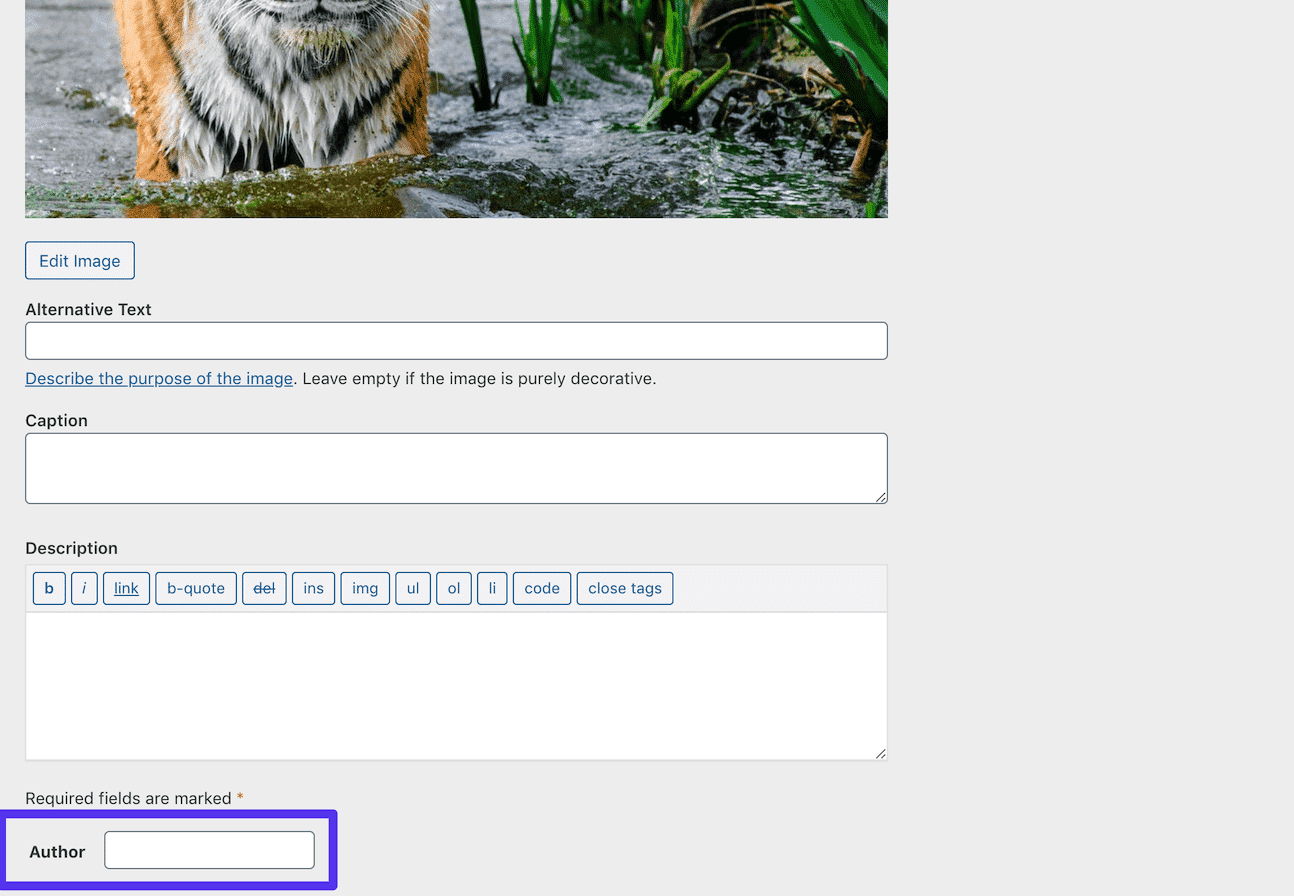
On the resulting screen, you'll see your new custom metadata field at the bottom:
The side by side step is saving the user input. You can accomplish this by hooking a new role to the edit_attachment activeness:
function media_hacks_edit_attachment( $attachment_id ){ if ( isset( $_REQUEST['attachments'][$attachment_id]['media_author'] ) ) { $media_author = $_REQUEST['attachments'][$attachment_id]['media_author']; update_post_meta( $attachment_id, 'media_author', $media_author ); } } add_action( 'edit_attachment', 'media_hacks_edit_attachment' ); This function keeps merely one argument: the $attachment_id of the current media file. Outset, the function checks to see whether a valid value for the custom meta field has been sent. Then it registers the value thanks to the update_post_meta function (see the code on Gist).
At present, y'all can call back the 'media_author' value thank you to the get_post_meta role:
$media_author = get_post_meta( $post->ID, 'media_author', true ); After that, yous can display information technology anywhere in the frontend.
ii. Display EXIF and IPTC Metadata in the Edit Media Screen
WordPress automatically stores extended metadata for JPEG and TIFF mime types. Now that you know how to add fields to the Edit Media screen via media.php, you can display this data.
To accomplish this chore, you take to change the first callback office every bit follows:
office media_hacks_attachment_fields_to_edit( $form_fields, $mail ){ // get mail mime type $type = get_post_mime_type( $mail->ID ); // get the attachment path $attachment_path = get_attached_file( $post->ID ); // get image metadata $metadata = wp_read_image_metadata( $attachment_path ); if( 'image/jpeg' == $blazon ){ if( $metadata ) { $exif_data = assortment( 'aperture' => 'Aperture', 'photographic camera' => 'Photographic camera', 'created_timestamp' => 'Timestamp', 'focal_length' => 'Focal Length', 'iso' => 'ISO', 'shutter_speed' => 'Exposure Fourth dimension', 'orientation' => 'Orientation' ); foreach ( $exif_data as $key => $value ) { $exif = $metadata[$primal]; $form_fields[$fundamental] = array( 'value' => $exif ? $exif : '', 'label' => __( $value ), 'input' => 'html', 'html' => "ID][$exif]' value='" . $exif . "' /> ); } } } return $form_fields; } add_filter( 'attachment_fields_to_edit', 'media_hacks_attachment_fields_to_edit', 10, 2 ); This snippet uses the following WordPress functions:
- get_post_mime_type retrieves the mime type of an attachment based on the ID.
- get_attached_file retrieves the fastened file path based on the ID.
- wp_read_image_metadata gets EXIF or IPTC metadata, if available.
If prototype mime blazon is "paradigm/jpeg", and if metadata exists, and then an assortment of required metadata is declared, and a form field for each element in the array is created:
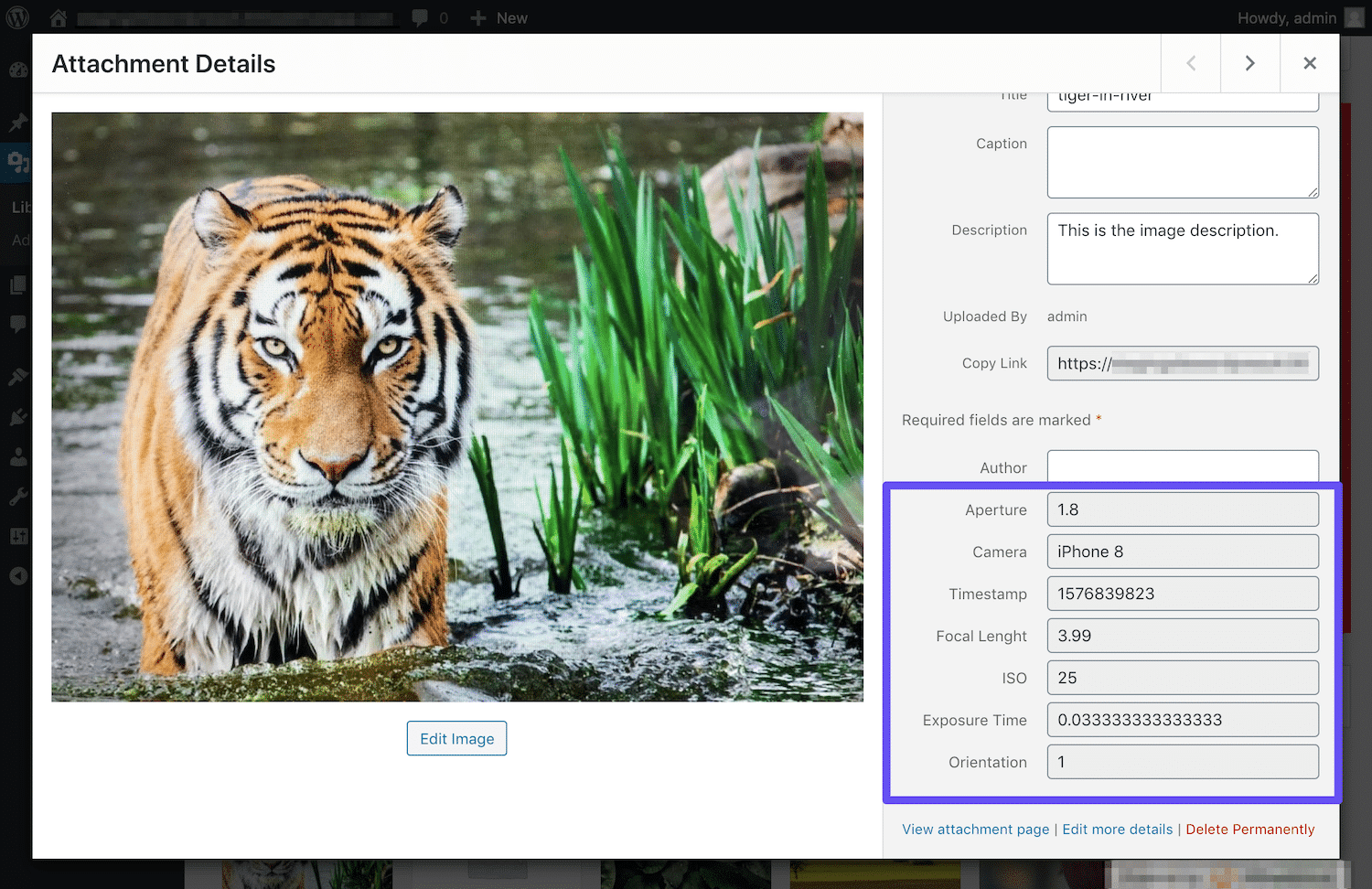
The grade fields of this example are a fleck more complex, as nosotros're setting a value for the 'html' form element (see the code on Gist). You don't demand to salvage EXIF and IPCT metadata, equally WordPress automatically stores them into the wp_postmeta table when uploading images.
3. Bear witness Extended Metadata on the Frontend
Having all of this information for yourself on the dorsum end is useful. However, if you besides desire to show extended metadata for your media files on the frontend, you'll need to do a piddling more than tinkering.
To do so, y'all can suspend this data to the attachment description using a the_content filter in wp-admin/includes/postal service.php, like and then:
part media_hacks_the_content( $content ){ global $post; if( is_attachment() && 'epitome/jpeg' == get_post_mime_type( $post->ID ) ) { $fields = wp_get_attachment_metadata( $postal service->ID ); $meta = $fields['image_meta']; if( ! empty( $meta['camera'] ) ){ $custom_content = " <ul> <li>Camera: {$meta['camera']}</li> <li>Created timestamp: {$meta['created_timestamp']}</li> <li>Aperture: {$meta['aperture']}</li> <li>Focal length: {$meta['focal_length']}</li> <li>ISO: {$meta['iso']}</li> <li>Shutter speed: {$meta['shutter_speed']}</li> <li>Orientation: {$meta['orientation']}</li> </ul>"; $content .= $custom_content; } } render $content; } add_filter( 'the_content', 'media_hacks_the_content' ); Hither, the wp_get_attachment_metadata function is chosen. If the current mail type is "attachment", and if the electric current mime blazon is "epitome/jpeg", and so the available image metadata is retrieved and used to build an unordered list of fields, which is appended to the mail content.
The callback function returns $content (see this lawmaking on Gist):
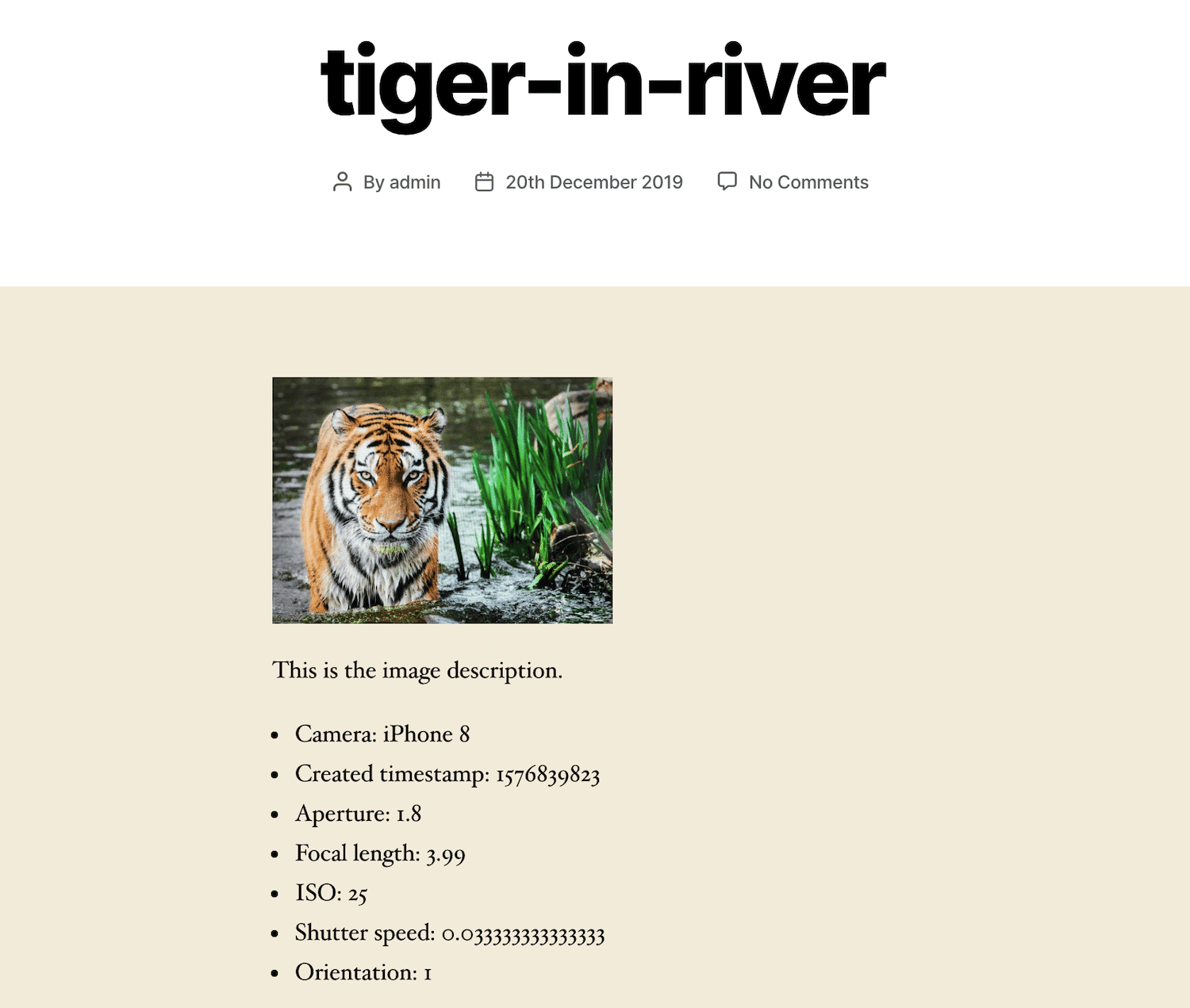
Above you can see the new attachment post with the metadata appended to the clarification.
iv. Publish a Photo Annal
Out of the box, WordPress does not display archives of attachments. This happens because the has_archive choice of the zipper post blazon is fix to false.
Moreover, while the default post_status parameter of the $query object is set to"publish", the default zipper post_status is gear up to "inherit". This means that no attachments will be shown in archives unless we explicitly set the query post_status to "inherit" or "any" (come across WP_Query Type Parameters for further information).
With that being said, in order to testify image archives, you have to define two functions. The starting time role filters the arguments of a specified post type, and sets the attachment has_archive holding to true:
function media_hacks_register_post_type_args( $args, $post_type ){ if( $post_type == 'zipper' ){ $args['has_archive'] = truthful; } return $args; } add_filter( 'register_post_type_args', 'media_hacks_register_post_type_args', ten, 2 ); The second function sets custom values for the post_mime_type and post_status query variables:
part media_hacks_pre_get_posts( $query ){ if ( !is_admin() && $query->is_main_query() ) { if( is_post_type_archive('attachment') ){ $query->gear up('post_mime_type', 'paradigm/jpeg'); $query->set( 'post_status', 'inherit' ); } } } add_action( 'pre_get_posts', 'media_hacks_pre_get_posts' ); The function is hooked to the pre_get_posts action hook, which is fired subsequently the query has been created, but before it's executed. The $query object is passed by reference, not by value, which means that any changes to the current instance of $query will affect the original $query object.
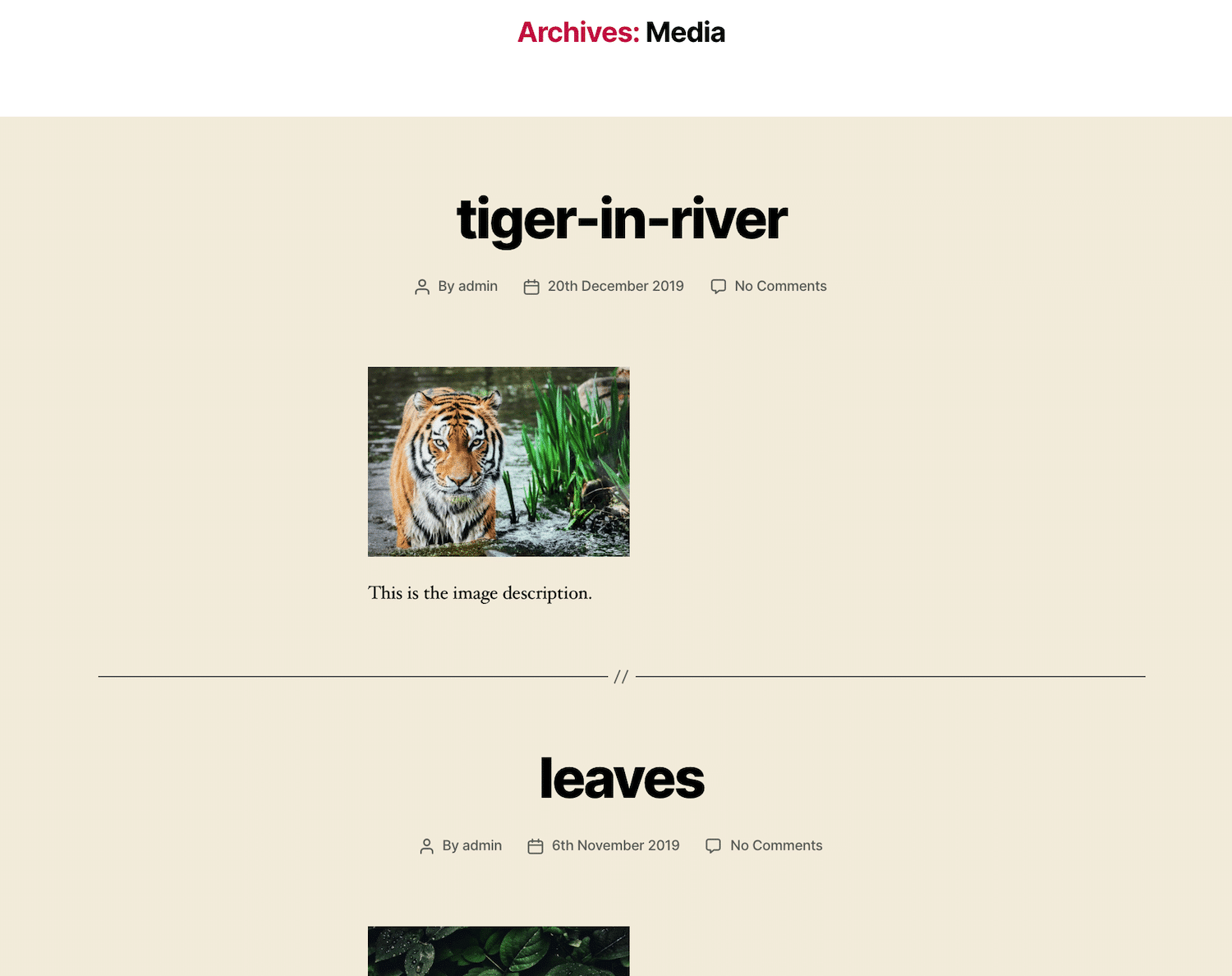
For this reason, it'southward important to verify which query you're going to alter (see this lawmaking on Gist). And so if you enter https://yourdomain.com/?post_type=zipper in your browser, you should see an archive of JPEG images:
The full lawmaking for all of these hacks is available as a plugin in a public Gist, which we've linked to through this section. You lot can download it every bit a .zip file and upload it to your WordPress site to implement all four of these hacks, without having to edit your files manually.
Summary
Images, videos, audio files, and documents tin can be extremely valuable to your site'due south users. The WordPress Media Library is essential to uploading, publishing, and even modifying these files in gild to come across the needs of your content.
Do you have any other questions near the WordPress Media Library? Let usa know in the comments department beneath!
Save time, costs and maximize site functioning with:
- Instant help from WordPress hosting experts, 24/seven.
- Cloudflare Enterprise integration.
- Global audition reach with 29 information centers worldwide.
- Optimization with our born Application Performance Monitoring.
All of that and much more, in one plan with no long-term contracts, assisted migrations, and a 30-day-coin-back-guarantee. Bank check out our plans or talk to sales to detect the plan that'south right for you.
Source: https://kinsta.com/blog/wordpress-media-library/
0 Response to "Plugin for Uploading and Downloading Documents on Wordpress Site"
Post a Comment